艉 (wěi) means "Stern (of a ship)" in Chinese. It has 13 strokes with the radical 舟.
Rated 4.2/5 in difficulty (advanced).
Appears in 3+ common words including 船艉 (chuán wěi), 艉灯 (wěi dēng), 艉轴 (wěi zhóu).
Due to its 13 strokes, Hanzi Writer's error detection shows 艉 requires focused practice — most learners need 10+ attempts for consistent accuracy.
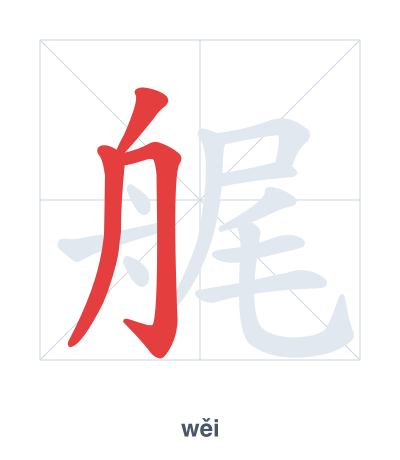
Open Hanzi Writer to see the animated stroke order and practice writing 艉 with real-time feedback.
The character 艉 (wěi) is written with 13 strokes. Follow the standard Chinese stroke order: top to bottom, left to right, outside before inside. The radical 舟 is one of its key components.
Practice the correct stroke order with the Hanzi Writer app to see animated stroke-by-stroke guidance with real-time feedback.
艉 means Stern (of a ship).
艉 is a compound character combining the radical 舟 (boat) with 尾 (tail). The tail (尾) represents the rear end of an animal, so together they depict the 'tail of a boat'—the stern. This reflects the logical construction of the character as the rear part of a vessel.
💡 Memory Tip: Picture a boat (舟) with a furry tail (尾) sticking out the back—that's the stern.
船艉挂着一面旗。
chuán wěi guà zhe yí miàn qí
A flag is hanging from the stern.
船艉灯亮起来了。
chuán wěi dēng liàng qǐ lái le
The stern light is lit.
工程师检查艉轴。
gōng chéng shī jiǎn chá wěi zhóu
The engineer is checking the tail shaft.
Open Hanzi Writer to see the animated stroke order and practice writing 艉 with real-time feedback.
✨ Animated stroke order · Handwriting recognition · HSK-graded practice · Free to use
艉 combines the radical 舟 (boat) on the left with 尾 (tail) on the right. The left part indicates the character relates to boats, and the right part suggests the rear or tail, together meaning the stern of a ship.