Hanzi Writer

How to Write 肄 (yì) — Meaning “to study; to practice”

13 strokes Radical: 聿

肄 (yì) means "to study; to practice" in Chinese. It has 13 strokes with the radical 聿.

Rated 4.2/5 in difficulty (advanced).

Appears in 3+ common words including 肄业 (yì yè), 肄习 (yì xí), 肄业生 (yì yè shēng).

Due to its 13 strokes, Hanzi Writer's error detection shows 肄 requires focused practice — most learners need 10+ attempts for consistent accuracy.
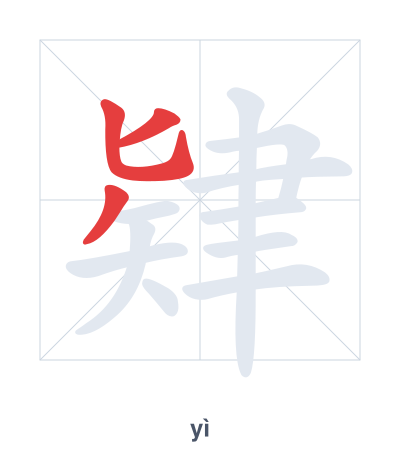
Stroke order practice for 肄 - yì

Practice Writing 肄 (yì)

Open Hanzi Writer to see the animated stroke order and practice writing 肄 with real-time feedback.

The character (yì) is written with 13 strokes. Follow the standard Chinese stroke order: top to bottom, left to right, outside before inside. The radical is one of its key components.

Practice the correct stroke order with the Hanzi Writer app to see animated stroke-by-stroke guidance with real-time feedback.

means to study; to practice.

Character
Pinyinyì (yi)
Meaningto study; to practice
Strokes13
Radical
Difficulty4.2/5

The character 肄 combines 聿 (a brush) with 隶 (originally a hand reaching out or capturing). Together they depict a hand holding a brush repeatedly, symbolizing the act of practicing or studying, especially calligraphy or writing.

💡 Memory Tip: Imagine a student holding a brush (聿) while a guiding hand (隶) moves it across paper again and again to practice.

yì yè
to leave school before graduation; to study at school
yì xí
to practice; to study
yì yè shēng
a student who has not yet graduated; a dropout

他在那所大学肄业了。

tā zài nà suǒ dà xué yì yè le

He attended that university but did not graduate.

学生们正在肄习功课。

xué shēng men zhèng zài yì xí gōng kè

The students are studying their lessons.

他是一名大学肄业生。

tā shì yī míng dà xué yì yè shēng

He is a college dropout.

Character Pinyin Strokes Radical
(current) 13
13
zhào 14
Stroke order practice for 肄 - yì

Practice Writing 肄 (yì)

Open Hanzi Writer to see the animated stroke order and practice writing 肄 with real-time feedback.

✨ Animated stroke order · Handwriting recognition · HSK-graded practice · Free to use

Frequently Asked Questions about 肄

肄 is composed of the radical 聿 (yù, meaning 'brush' or 'writing') on the left, and the phonetic component 㐌 on the right. The radical suggests writing or study, while the right side provides pronunciation (yì). Together, the structure conveys the idea of using a brush to practice or study.

Characters with Radical 聿

Other 13-Stroke Characters