肇 (zhào) means "to cause / to start / to initiate" in Chinese. It has 14 strokes with the radical 聿, and is HSK Level 7.
Rated 4.2/5 in difficulty (advanced).
Harder than 83% of HSK Level 7 characters.
Appears in 3+ common words including 肇事 (zhào shì), 肇始 (zhào shǐ), 肇祸 (zhào huò).
Due to its 14 strokes, Hanzi Writer's error detection shows 肇 requires focused practice — most learners need 10+ attempts for consistent accuracy.
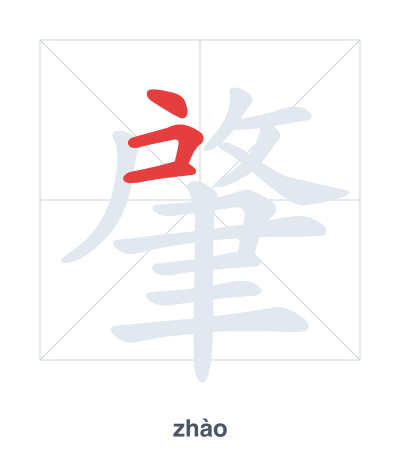
Open Hanzi Writer to see the animated stroke order and practice writing 肇 with real-time feedback.
The character 肇 (zhào) is written with 14 strokes. Follow the standard Chinese stroke order: top to bottom, left to right, outside before inside. The radical 聿 is one of its key components.
Practice the correct stroke order with the Hanzi Writer app to see animated stroke-by-stroke guidance with real-time feedback.
肇 means to cause / to start / to initiate.
As an HSK Level 7 character, 肇 is an intermediate-level character.
肇 combines 户 (door), 聿 (brush), and 攵 (hand with a stick). The door suggests an opening or beginning, the brush represents recording or writing, and the hand action indicates doing—together they convey the idea of initiating or causing something to start.
💡 Memory Tip: Picture a hand (攵) pushing open a door (户) to begin writing (聿) a new chapter.
他开车肇事了。
tā kāi chē zhào shì le
He caused an accident while driving.
这是文化的肇始。
zhè shì wén huà de zhào shǐ
This is the origin of culture.
别在这里肇祸。
bié zài zhè lǐ zhào huò
Don't cause trouble here.
Open Hanzi Writer to see the animated stroke order and practice writing 肇 with real-time feedback.
✨ Animated stroke order · Handwriting recognition · HSK-graded practice · Free to use
肇 is composed of three parts: 户 (door), 攵 (action), and 聿 (brush). The door suggests a starting point, the action part indicates doing something, and the brush represents the beginning of writing or recording. Together they convey the idea of initiating or causing something to happen.