蟀 (shuài) means "cricket" in Chinese. It has 17 strokes with the radical 虫.
Rated 4.2/5 in difficulty (advanced).
Appears in 3+ common words including 蟋蟀 (xī shuài), 斗蟋蟀 (dòu xī shuài), 蟋蟀声 (xī shuài shēng).
Due to its 17 strokes, Hanzi Writer's error detection shows 蟀 requires focused practice — most learners need 10+ attempts for consistent accuracy.
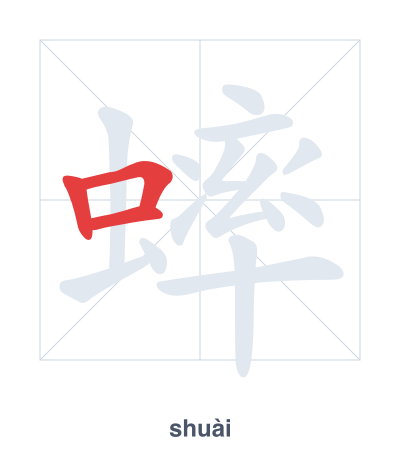
Open Hanzi Writer to see the animated stroke order and practice writing 蟀 with real-time feedback.
The character 蟀 (shuài) is written with 17 strokes. Follow the standard Chinese stroke order: top to bottom, left to right, outside before inside. The radical 虫 is one of its key components.
Practice the correct stroke order with the Hanzi Writer app to see animated stroke-by-stroke guidance with real-time feedback.
蟀 means cricket.
蟀 is a phono-semantic compound: the radical 虫 (insect) indicates its meaning as a cricket, while 率 (shuài) provides the pronunciation hint. The character visually combines an insect with a component meaning 'rate' or 'lead,' suggesting the cricket's chirping rate or leadership in sound.
💡 Memory Tip: Imagine a cricket (虫) leading the chorus with its rapid chirping, hitting a perfect rate (率) of beats per second.
蟋蟀在草丛里叫。
xī shuài zài cǎo cóng lǐ jiào
The cricket is chirping in the grass.
爷爷喜欢斗蟋蟀。
yé yé xǐ huān dòu xī shuài
Grandpa likes cricket fighting.
我听到了蟋蟀声。
wǒ tīng dào le xī shuài shēng
I heard the sound of crickets.
Open Hanzi Writer to see the animated stroke order and practice writing 蟀 with real-time feedback.
✨ Animated stroke order · Handwriting recognition · HSK-graded practice · Free to use
蟀 is composed of the radical 虫 (insect) on the left, and the phonetic component 率 (shuài) on the right. The radical indicates that this character refers to an insect, which matches the meaning "cricket." The right side gives a clue to the pronunciation shuài, though it does not directly relate to the meaning.