蟋 (xī) means "cricket" in Chinese. It has 17 strokes with the radical 虫.
Rated 4.2/5 in difficulty (advanced).
Appears in 3+ common words including 蟋蟀 (xī shuài), 蟋蟀草 (xī shuài cǎo), 小蟋蟀 (xiǎo xī shuài).
Due to its 17 strokes, Hanzi Writer's error detection shows 蟋 requires focused practice — most learners need 10+ attempts for consistent accuracy.
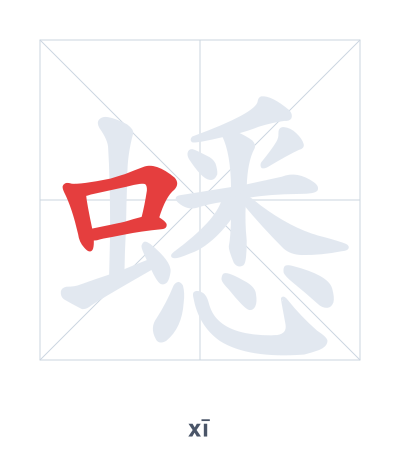
Open Hanzi Writer to see the animated stroke order and practice writing 蟋 with real-time feedback.
The character 蟋 (xī) is written with 17 strokes. Follow the standard Chinese stroke order: top to bottom, left to right, outside before inside. The radical 虫 is one of its key components.
Practice the correct stroke order with the Hanzi Writer app to see animated stroke-by-stroke guidance with real-time feedback.
蟋 means cricket.
蟋 is a compound character where the radical 虫 (insect) indicates the meaning, and the component 悉 (xī, meaning 'all' or 'know') provides the sound. The cricket is known for its pervasive chirping, which aligns with the idea of 'knowing all' or being heard everywhere.
💡 Memory Tip: Imagine a cricket (虫) that knows all the secrets (悉) because it chirps everywhere, revealing everything at night.
蟋蟀在唱歌。
xī shuài zài chàng gē
The cricket is singing.
地上有许多蟋蟀草。
dì shàng yǒu xǔ duō xī shuài cǎo
There is a lot of goosegrass on the ground.
这是一只小蟋蟀。
zhè shì yī zhī xiǎo xī shuài
This is a small cricket.
Open Hanzi Writer to see the animated stroke order and practice writing 蟋 with real-time feedback.
✨ Animated stroke order · Handwriting recognition · HSK-graded practice · Free to use
蟋 is a left-right character. The left component 虫 is the insect radical, showing that the character refers to an insect. The right part 悉 provides the pronunciation xī and does not directly carry the meaning of "cricket".