倏 (shū) means "Suddenly; abruptly." in Chinese. It has 10 strokes with the radical 亻.
Rated 3.9/5 in difficulty (challenging).
Appears in 3+ common words including 倏忽 (shū hū), 倏地 (shū dì), 倏然 (shū rán).
Due to its 10 strokes, Hanzi Writer's error detection shows 倏 requires focused practice — most learners need 10+ attempts for consistent accuracy.
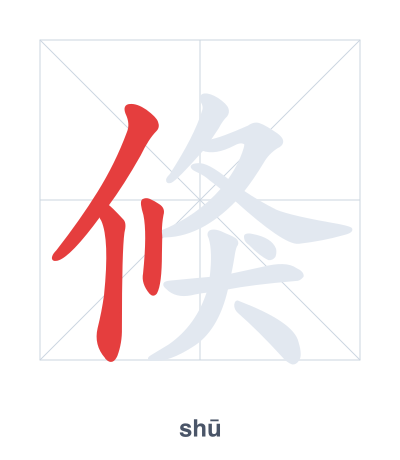
Open Hanzi Writer to see the animated stroke order and practice writing 倏 with real-time feedback.
The character 倏 (shū) is written with 10 strokes. Follow the standard Chinese stroke order: top to bottom, left to right, outside before inside. The radical 亻 is one of its key components.
Practice the correct stroke order with the Hanzi Writer app to see animated stroke-by-stroke guidance with real-time feedback.
倏 means Suddenly; abruptly..
倏 combines the radical 亻 (person) with 攸, which originally showed flowing water moving swiftly—together they suggest a person acting abruptly, like a sudden rush of water.
💡 Memory Tip: A person (亻) suddenly leaps into a swift stream (攸), vanishing in an instant.
时间倏忽而逝。
shí jiān shū hū ér shì
Time flies by in an instant.
小猫倏地跳走了。
xiǎo māo shū dì tiào zǒu le
The kitten suddenly jumped away.
灯光倏然熄灭了。
dēng guāng shū rán xī miè le
The lights suddenly went out.
Open Hanzi Writer to see the animated stroke order and practice writing 倏 with real-time feedback.
✨ Animated stroke order · Handwriting recognition · HSK-graded practice · Free to use
倏 is made of the radical 亻 (person) on the left and the phonetic part 攸 (yōu) on the right. The person radical hints that the character often describes a person's action or state, while 攸 provides the sound shū. The meaning 'suddenly' comes from the whole character, not directly from the parts, but 攸 itself can imply a swift movement in some contexts.