忽 (hū) means "suddenly; to neglect; to ignore" in Chinese. It has 8 strokes with the radical 心, and is HSK Level 2.
Rated 3.2/5 in difficulty (challenging).
Harder than 47% of HSK Level 2 characters.
Appears in 3+ common words including 忽然 (hū rán), 忽略 (hū lüè), 忽快忽慢 (hū kuài hū màn).
Due to its 8 strokes, Hanzi Writer's error detection shows 忽 requires focused practice — most learners need 10+ attempts for consistent accuracy.
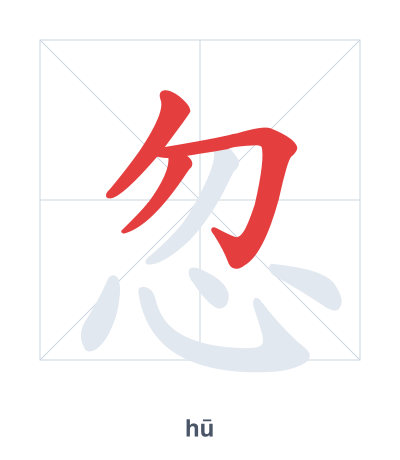
Open Hanzi Writer to see the animated stroke order and practice writing 忽 with real-time feedback.
The character 忽 (hū) is written with 8 strokes. Follow the standard Chinese stroke order: top to bottom, left to right, outside before inside. The radical 心 is one of its key components.
Practice the correct stroke order with the Hanzi Writer app to see animated stroke-by-stroke guidance with real-time feedback.
忽 means suddenly; to neglect; to ignore.
As an HSK Level 2 character, 忽 is among the first characters beginners learn.
忽 is a phono-semantic compound: 勿 (wù) provides the sound, while 心 (heart/mind) hints at the meaning of a sudden shift in thought or attention. The character originally depicted the idea of a mind abruptly changing or losing focus, leading to neglect.
💡 Memory Tip: Picture a 'No Entry' sign (勿) suddenly slamming onto your heart (心), making you instantly ignore everything else.
天忽然下雨了。
tiān hū rán xià yǔ le
It suddenly started raining.
不要忽略小问题。
bú yào hū lüè xiǎo wèn tí
Don't ignore small problems.
车速忽快忽慢。
chē sù hū kuài hū màn
The vehicle's speed is inconsistent.
Open Hanzi Writer to see the animated stroke order and practice writing 忽 with real-time feedback.
✨ Animated stroke order · Handwriting recognition · HSK-graded practice · Free to use
忽 is made of two parts: the top component 勿 (wù, meaning 'do not') and the bottom radical 心 (xīn, 'heart'). The heart radical connects to feelings or attention, while 勿 adds a sense of 'not doing' — together they suggest ignoring or neglecting something, or a sudden change in mental state.