鲺 (shī) means "Fish louse" in Chinese. It has 16 strokes with the radical 鱼.
Rated 4.2/5 in difficulty (advanced).
Appears in 3+ common words including 鱼鲺 (yú shī), 鲺病 (shī bìng), 寄生鲺 (jì shēng shī).
Due to its 16 strokes, Hanzi Writer's error detection shows 鲺 requires focused practice — most learners need 10+ attempts for consistent accuracy.
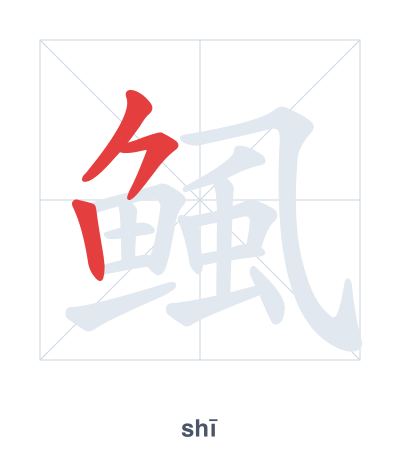
Open Hanzi Writer to see the animated stroke order and practice writing 鲺 with real-time feedback.
The character 鲺 (shī) is written with 16 strokes. Follow the standard Chinese stroke order: top to bottom, left to right, outside before inside. The radical 鱼 is one of its key components.
Practice the correct stroke order with the Hanzi Writer app to see animated stroke-by-stroke guidance with real-time feedback.
鲺 means Fish louse.
鲺 is a compound character combining the radical 鱼 (fish) with 虱 (louse). The left part indicates the creature is related to fish, while the right part 虱 provides the pronunciation and suggests it is a kind of louse that parasitizes fish.
💡 Memory Tip: Imagine a fish (鱼) covered in tiny lice (虱), wriggling uncomfortably—that's the fish louse (鲺).
鱼鲺是一种鱼类寄生虫。
yú shī shì yī zhǒng yú lèi jì shēng chóng
Fish lice are a type of fish parasite.
鱼缸里的鱼生了鲺病。
yú gāng lǐ de yú shēng le shī bìng
The fish in the tank have fish lice.
寄生鲺会吸取鱼的营养。
jì shēng shī huì xī qǔ yú de yíng yǎng
Fish lice absorb nutrients from fish.
Open Hanzi Writer to see the animated stroke order and practice writing 鲺 with real-time feedback.
✨ Animated stroke order · Handwriting recognition · HSK-graded practice · Free to use
鲺 has two parts: the left radical 鱼 means "fish," and the right part 虱 means "louse." Together they show a fish louse, which is a parasite that lives on fish. This combination directly describes the creature's relationship to its host.