鲒 (jié) means "Oyster" in Chinese. It has 14 strokes with the radical 鱼.
Rated 4.2/5 in difficulty (advanced).
Appears in 3+ common words including 鲒子 (jié zi), 鲒蚌 (jié bàng), 鲒亭 (jié tíng).
Due to its 14 strokes, Hanzi Writer's error detection shows 鲒 requires focused practice — most learners need 10+ attempts for consistent accuracy.
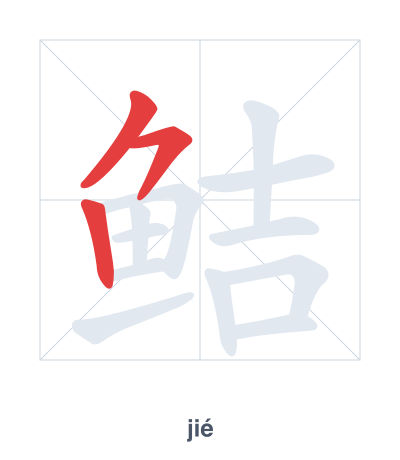
Open Hanzi Writer to see the animated stroke order and practice writing 鲒 with real-time feedback.
The character 鲒 (jié) is written with 14 strokes. Follow the standard Chinese stroke order: top to bottom, left to right, outside before inside. The radical 鱼 is one of its key components.
Practice the correct stroke order with the Hanzi Writer app to see animated stroke-by-stroke guidance with real-time feedback.
鲒 means Oyster.
鲒 is a phono-semantic compound formed with the radical 鱼 (fish/sea creature) on the left and the phonetic component 吉 (jí, meaning 'lucky') on the right. The radical indicates it is an aquatic animal, while 吉 adds pronunciation and no direct meaning.
💡 Memory Tip: Imagine a lucky (吉) oyster (鱼) that opens to reveal a gleaming pearl inside—definitely a lucky catch!
鲒子是一种贝类。
jié zi shì yī zhǒng bèi lèi
The oyster is a type of shellfish.
水里有鲒蚌。
shuǐ lǐ yǒu jié bàng
There are clams and mussels in the water.
鲒亭是一个地名。
jié tíng shì yí gè dì míng
Jieting is a place name.
Open Hanzi Writer to see the animated stroke order and practice writing 鲒 with real-time feedback.
✨ Animated stroke order · Handwriting recognition · HSK-graded practice · Free to use
The character 鲒 is composed of the radical 鱼 (fish, seafood) on the left and 吉 (jí, meaning auspicious) on the right. The radical indicates that 鲒 is a type of seafood, specifically an oyster, while the right side 吉 gives the character its pronunciation jié. This combination of meaning and sound is common in Chinese characters.