Hanzi Writer

How to Write 鲔 (wěi) — Meaning “Tuna”

wěi 14 strokes Radical: 鱼

鲔 (wěi) means "Tuna" in Chinese. It has 14 strokes with the radical 鱼.

Rated 4.2/5 in difficulty (advanced).

Appears in 3+ common words including 鲔鱼 (wěi yú), 鲔鱼罐头 (wěi yú guàn tou), 鲔鱼饭团 (wěi yú fàn tuán).

Due to its 14 strokes, Hanzi Writer's error detection shows 鲔 requires focused practice — most learners need 10+ attempts for consistent accuracy.
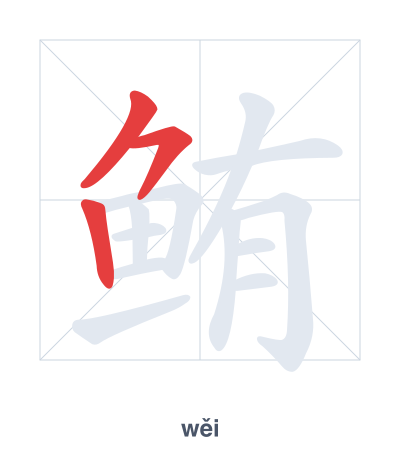
Stroke order practice for 鲔 - wěi

Practice Writing 鲔 (wěi)

Open Hanzi Writer to see the animated stroke order and practice writing 鲔 with real-time feedback.

The character (wěi) is written with 14 strokes. Follow the standard Chinese stroke order: top to bottom, left to right, outside before inside. The radical is one of its key components.

Practice the correct stroke order with the Hanzi Writer app to see animated stroke-by-stroke guidance with real-time feedback.

means Tuna.

Character
Pinyinwěi (wei)
MeaningTuna
Strokes14
Radical
Difficulty4.2/5

鲔 is a compound character with the radical 鱼 (fish) on the left and 有 (yǒu) on the right, which originally depicted a hand holding meat and serves as a phonetic component. In ancient Chinese, 鲔 referred to large fish like sturgeon or tuna, so the character visually suggests 'a fish that is substantial.'

💡 Memory Tip: Picture a tuna fish (鱼) that has (有) a giant fork sticking out of its back, ready for your dinner plate.

wěi yú
Tuna
wěi yú guàn tou
Canned tuna
wěi yú fàn tuán
Tuna rice ball

鲔鱼游得很快。

wěi yú yóu dé hěn kuài

Tuna swim very fast.

我买了一罐鲔鱼。

wǒ mǎi le yī guàn wěi yú

I bought a can of tuna.

我早饭吃鲔鱼饭团。

wǒ zǎo fàn chī wěi yú fàn tuán

I have a tuna rice ball for breakfast.

Character Pinyin Strokes Radical
(current) wěi 14
鱿 yóu 12
12
fáng 12
Stroke order practice for 鲔 - wěi

Practice Writing 鲔 (wěi)

Open Hanzi Writer to see the animated stroke order and practice writing 鲔 with real-time feedback.

✨ Animated stroke order · Handwriting recognition · HSK-graded practice · Free to use

Frequently Asked Questions about 鲔

鲔 combines the radical 鱼 (fish) on the left with 有 (yǒu, to have) on the right. The left part shows it is a type of fish, and the right part hints at its pronunciation wěi. Together they form the character for tuna.

Characters with Radical 鱼

Other 14-Stroke Characters