鲑 (guī) means "Salmon" in Chinese. It has 14 strokes with the radical 鱼.
Rated 4.2/5 in difficulty (advanced).
Appears in 3+ common words including 鲑鱼 (guī yú), 鲑鱼肉 (guī yú ròu), 红鲑 (hóng guī).
Due to its 14 strokes, Hanzi Writer's error detection shows 鲑 requires focused practice — most learners need 10+ attempts for consistent accuracy.
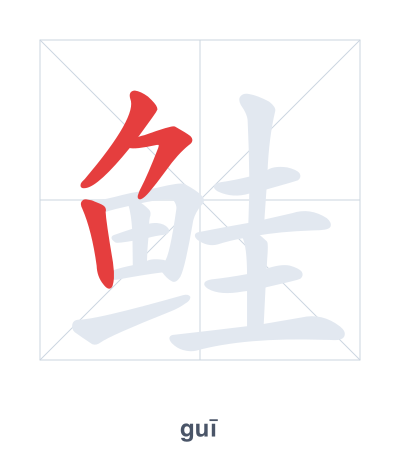
Open Hanzi Writer to see the animated stroke order and practice writing 鲑 with real-time feedback.
The character 鲑 (guī) is written with 14 strokes. Follow the standard Chinese stroke order: top to bottom, left to right, outside before inside. The radical 鱼 is one of its key components.
Practice the correct stroke order with the Hanzi Writer app to see animated stroke-by-stroke guidance with real-time feedback.
鲑 means Salmon.
The character 鲑 is a phono-semantic compound: the radical 鱼 (fish) indicates it's a type of fish, while the component 圭 (guī, a jade tablet) provides the pronunciation. This structure tells us that 鲑 refers to a fish called salmon, with the sound borrowed from 圭.
💡 Memory Tip: Picture a salmon (鱼) proudly wearing a jade tablet (圭) like a royal pendant as it swims upstream.
鲑鱼在河里产卵。
guī yú zài hé lǐ chǎn luǎn
Salmon spawn in rivers.
鲑鱼肉是红色的。
guī yú ròu shì hóng sè de
Salmon meat is red.
红鲑是一种好鱼。
hóng guī shì yī zhǒng hǎo yú
Sockeye salmon is a good kind of fish.
Open Hanzi Writer to see the animated stroke order and practice writing 鲑 with real-time feedback.
✨ Animated stroke order · Handwriting recognition · HSK-graded practice · Free to use
鲑 is composed of the radical 鱼 (fish) on the left and the phonetic component 圭 (guī) on the right. The radical tells you the character is related to fish, while the right side gives a hint to its pronunciation. Together they form the word for 'salmon', a specific type of fish.