嬗 (shàn) means "To evolve; to change; to hand over" in Chinese. It has 16 strokes with the radical 女.
Rated 4.2/5 in difficulty (advanced).
Appears in 3+ common words including 嬗变 (shàn biàn), 递嬗 (dì shàn), 演嬗 (yǎn shàn).
Due to its 16 strokes, Hanzi Writer's error detection shows 嬗 requires focused practice — most learners need 10+ attempts for consistent accuracy.
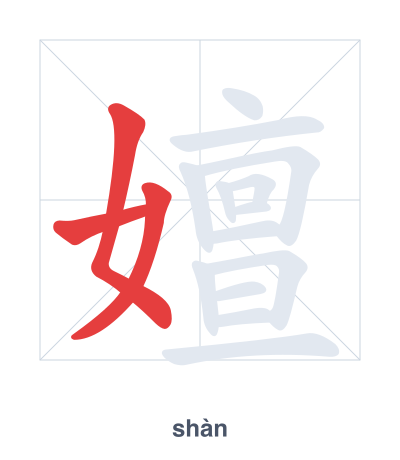
Open Hanzi Writer to see the animated stroke order and practice writing 嬗 with real-time feedback.
The character 嬗 (shàn) is written with 16 strokes. Follow the standard Chinese stroke order: top to bottom, left to right, outside before inside. The radical 女 is one of its key components.
Practice the correct stroke order with the Hanzi Writer app to see animated stroke-by-stroke guidance with real-time feedback.
嬗 means To evolve; to change; to hand over.
嬗 combines the radical 女 (woman) and the phonetic component 亶 (dǎn, originally meaning 'sincere' or 'abundant'). The woman radical often relates to lineage or hereditary succession, while the whole character conveys the sense of gradual change or transmission, as in the transfer of power or transformation over time.
💡 Memory Tip: Picture a woman (女) holding a heavy bundle (亶) and slowly handing it to the next person, symbolizing an evolution or change of ownership.
时代在不断嬗变。
shí dài zài bù duàn shàn biàn
The era is constantly evolving.
四季在不停地递嬗。
sì jì zài bù tíng dì dì shàn
The four seasons are constantly evolving.
这种文化经历了演嬗。
zhè zhǒng wén huà jīng lì le yǎn shàn
This culture has undergone evolution.
Open Hanzi Writer to see the animated stroke order and practice writing 嬗 with real-time feedback.
✨ Animated stroke order · Handwriting recognition · HSK-graded practice · Free to use
The character 嬗 has the radical 女 (woman) on the left and a right side made of 亻 (person) above 㕚 (a claw-like shape). This structure suggests a person using a claw to hand something over to a woman, representing the ideas of change, evolution, or transfer. The combination visually implies an action of passing or transforming.