歃 (shà) means "to smear blood (as an oath)" in Chinese. It has 13 strokes with the radical 欠.
Rated 4.2/5 in difficulty (advanced).
Appears in 2+ common words including 歃血 (shà xuè), 歃盟 (shà méng).
Due to its 13 strokes, Hanzi Writer's error detection shows 歃 requires focused practice — most learners need 10+ attempts for consistent accuracy.
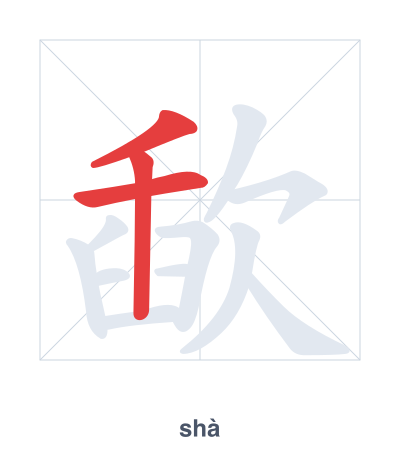
Open Hanzi Writer to see the animated stroke order and practice writing 歃 with real-time feedback.
The character 歃 (shà) is written with 13 strokes. Follow the standard Chinese stroke order: top to bottom, left to right, outside before inside. The radical 欠 is one of its key components.
Practice the correct stroke order with the Hanzi Writer app to see animated stroke-by-stroke guidance with real-time feedback.
歃 means to smear blood (as an oath).
| Character | 歃 |
| Pinyin | shà (sha) |
| Meaning | to smear blood (as an oath) |
| Strokes | 13 |
| Radical | 欠 |
| Difficulty | 4.2/5 |
歃 combines 合 (to join/unite) and 欠 (open mouth, blowing). The ancient ritual involved smearing blood on the lips to seal an oath, so the character depicts the mouth receiving a unifying substance—blood—as a pledge.
💡 Memory Tip: Picture a person with an open mouth (欠) receiving a bowl of blood (合) to smear as an oath.
他们歃血为盟。
tā men shà xuè wéi méng
They swore a blood oath.
双方在此歃盟。
shuāng fāng zài cǐ shà méng
Both sides swore an alliance here.
这是一个歃血仪式。
zhè shì yí gè shà xuè yí shì
This is a blood oath ceremony.
Open Hanzi Writer to see the animated stroke order and practice writing 歃 with real-time feedback.
✨ Animated stroke order · Handwriting recognition · HSK-graded practice · Free to use
歃 is composed of 合 (hé, meaning 'to unite' or 'to close') on the left and 欠 (qiàn, meaning 'mouth open' or 'yawn') on the right. Together, they suggest the action of uniting by opening the mouth to smear blood, which reflects the ancient oath ritual.