唼 (shà) means "sound of fish or birds eating" in Chinese. It has 11 strokes with the radical 口.
Rated 4.2/5 in difficulty (advanced).
Appears in 2+ common words including 唼喋 (shà dié), 唼 (shà).
Due to its 11 strokes, Hanzi Writer's error detection shows 唼 requires focused practice — most learners need 10+ attempts for consistent accuracy.
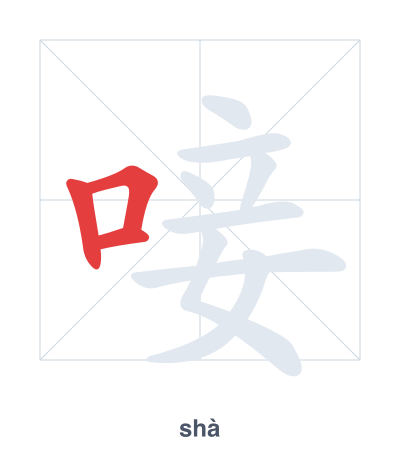
Open Hanzi Writer to see the animated stroke order and practice writing 唼 with real-time feedback.
The character 唼 (shà) is written with 11 strokes. Follow the standard Chinese stroke order: top to bottom, left to right, outside before inside. The radical 口 is one of its key components.
Practice the correct stroke order with the Hanzi Writer app to see animated stroke-by-stroke guidance with real-time feedback.
唼 means sound of fish or birds eating.
唼 (shà) is a compound character: the radical 口 (mouth) indicates the sound or action of eating, while the component 妾 (qiè, meaning concubine) provides a phonetic hint—though its modern pronunciation differs, ancient readings may have been closer. Together, they depict the sound of fish or birds sipping food with their mouths.
💡 Memory Tip: Picture a concubine (妾) making exaggerated smacking sounds with her mouth (口) as she eats like a fish.
鱼在水中唼喋。
yú zài shuǐ zhōng shà dié
The fish are feeding on the surface of the water.
听到唼的一声。
tīng dào shà de yī shēng
Heard a nibbling sound.
水鸟在唼食。
shuǐ niǎo zài shà shí
The water bird is dabbling for food.
Open Hanzi Writer to see the animated stroke order and practice writing 唼 with real-time feedback.
✨ Animated stroke order · Handwriting recognition · HSK-graded practice · Free to use
唼 is a pictophonetic character. The left component 口 (mouth) indicates it relates to sounds from the mouth, while the right component 妾 provides the pronunciation shà. Together they form a character meaning the sound made by fish or birds when eating.