桑 (sāng) means "Mulberry" in Chinese. It has 10 strokes with the radical 木, and is HSK Level 7.
Rated 4.2/5 in difficulty (advanced).
Harder than 63% of HSK Level 7 characters.
Appears in 3+ common words including 桑树 (sāng shù), 桑叶 (sāng yè), 桑葚 (sāng shèn).
Due to its 10 strokes, Hanzi Writer's error detection shows 桑 requires focused practice — most learners need 10+ attempts for consistent accuracy.
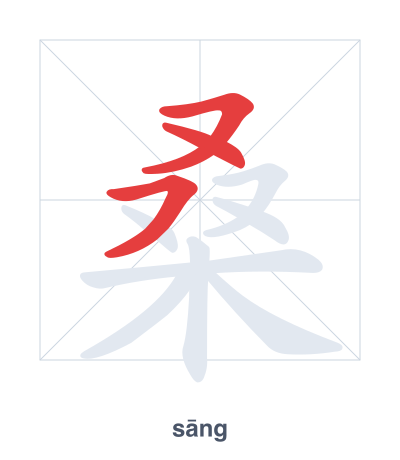
Open Hanzi Writer to see the animated stroke order and practice writing 桑 with real-time feedback.
The character 桑 (sāng) is written with 10 strokes. Follow the standard Chinese stroke order: top to bottom, left to right, outside before inside. The radical 木 is one of its key components.
Practice the correct stroke order with the Hanzi Writer app to see animated stroke-by-stroke guidance with real-time feedback.
桑 means Mulberry.
As an HSK Level 7 character, 桑 is an intermediate-level character.
桑 combines the tree radical 木 with three hands (又), representing hands picking mulberries or mulberry leaves from the tree. The ancient form depicted a mulberry tree with multiple hands gathering its leaves for silk cultivation.
💡 Memory Tip: Picture three hands (三又) greedily reaching into a tree (木) to pluck delicious purple mulberries.
院子里种了一棵桑树。
yuàn zi lǐ zhǒng le yī kē sāng shù
A mulberry tree is planted in the yard.
蚕最喜欢吃桑叶。
cán zuì xǐ huān chī sāng yè
Silkworms like eating mulberry leaves the most.
成熟的桑葚非常甜。
chéng shú de sāng shèn fēi cháng tián
Ripe mulberries are very sweet.
Open Hanzi Writer to see the animated stroke order and practice writing 桑 with real-time feedback.
✨ Animated stroke order · Handwriting recognition · HSK-graded practice · Free to use
桑 is made of three 又 (hands) on top of 木 (tree), suggesting the idea of picking or gathering leaves from a mulberry tree. The tree radical 木 gives the meaning of tree, while the three hands imply the action of harvesting mulberry leaves for silkworms.