鹊 (què) means "magpie" in Chinese. It has 13 strokes with the radical 鸟.
Rated 4.2/5 in difficulty (advanced).
Appears in 3+ common words including 喜鹊 (xǐ què), 鹊桥 (què qiáo), 喜鹊叫 (xǐ què jiào).
Due to its 13 strokes, Hanzi Writer's error detection shows 鹊 requires focused practice — most learners need 10+ attempts for consistent accuracy.
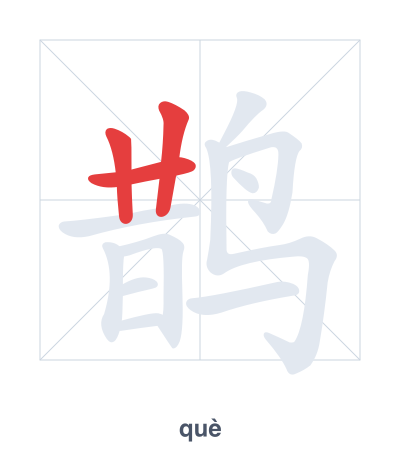
Open Hanzi Writer to see the animated stroke order and practice writing 鹊 with real-time feedback.
The character 鹊 (què) is written with 13 strokes. Follow the standard Chinese stroke order: top to bottom, left to right, outside before inside. The radical 鸟 is one of its key components.
Practice the correct stroke order with the Hanzi Writer app to see animated stroke-by-stroke guidance with real-time feedback.
鹊 means magpie.
鹊 is a phono-semantic compound: the right radical 鸟 (bird) indicates it's a type of bird, while the left component 昔 (ancient) provides a phonetic clue to the pronunciation 'què'. The character refers specifically to the magpie, a bird known for its chattering call.
💡 Memory Tip: Picture an ancient (昔) bird (鸟) that always chatters 'què-què'—that's the magpie.
树上有一只喜鹊。
shù shàng yǒu yī zhī xǐ què
There is a magpie in the tree.
传说他们相会在鹊桥。
chuán shuō tā men xiāng huì zài què qiáo
Legend says they meet on the Magpie Bridge.
喜鹊叫,好事到。
xǐ què jiào hǎo shì dào
When the magpie chirps, good things are coming.
Open Hanzi Writer to see the animated stroke order and practice writing 鹊 with real-time feedback.
✨ Animated stroke order · Handwriting recognition · HSK-graded practice · Free to use
The character 鹊 is composed of the radical 鸟 (bird) on the right, and the left part 昔 (meaning "past" or "formerly"). Together, they suggest a bird with a long history or a familiar bird, which connects to the magpie, a common and culturally significant bird in China.