鸹 (guā) means "crow / raven" in Chinese. It has 11 strokes with the radical 鸟.
Rated 4.2/5 in difficulty (advanced).
Appears in 3+ common words including 老鸹 (lǎo guā), 鸹叫 (guā jiào), 鸹噪 (guā zào).
Due to its 11 strokes, Hanzi Writer's error detection shows 鸹 requires focused practice — most learners need 10+ attempts for consistent accuracy.
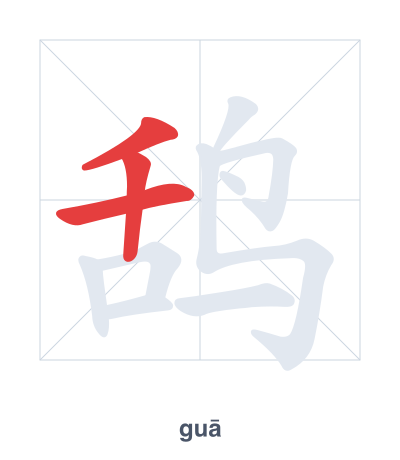
Open Hanzi Writer to see the animated stroke order and practice writing 鸹 with real-time feedback.
The character 鸹 (guā) is written with 11 strokes. Follow the standard Chinese stroke order: top to bottom, left to right, outside before inside. The radical 鸟 is one of its key components.
Practice the correct stroke order with the Hanzi Writer app to see animated stroke-by-stroke guidance with real-time feedback.
鸹 means crow / raven.
This character is a compound of the radical 鸟 (bird) and 舌 (tongue), likely representing a bird known for its harsh, distinctive call, such as a crow or raven. The tongue component phonetically hints at the sound, while the bird radical provides the semantic category.
💡 Memory Tip: Picture a crow with its tongue (舌) sticking out as it caws 'guā', perched on the right side of a bird (鸟) shape.
树上有只老鸹。
shù shàng yǒu zhǐ lǎo guā
There is a crow in the tree.
听到了老鸹叫声。
tīng dào le lǎo guā jiào shēng
Heard the caw of a crow.
别在这里鸹噪。
bié zài zhè lǐ guā zào
Don't make a din here.
Open Hanzi Writer to see the animated stroke order and practice writing 鸹 with real-time feedback.
✨ Animated stroke order · Handwriting recognition · HSK-graded practice · Free to use
鸹 is a left-right character: the left part is 舌 (tongue) and the right part is 鸟 (bird). The tongue component may hint at the cawing sound crows make, and the bird radical directly points to its meaning of crow or raven.