鲭 (qīng) means "Mackerel" in Chinese. It has 16 strokes with the radical 鱼.
Rated 4.2/5 in difficulty (advanced).
Appears in 3+ common words including 鲭鱼 (qīng yú), 烤鲭鱼 (kǎo qīng yú), 咸鲭鱼 (xián qīng yú).
Due to its 16 strokes, Hanzi Writer's error detection shows 鲭 requires focused practice — most learners need 10+ attempts for consistent accuracy.
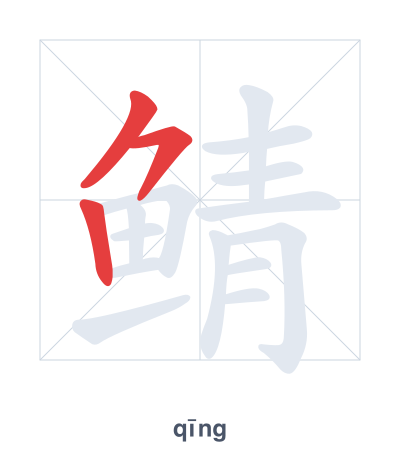
Open Hanzi Writer to see the animated stroke order and practice writing 鲭 with real-time feedback.
The character 鲭 (qīng) is written with 16 strokes. Follow the standard Chinese stroke order: top to bottom, left to right, outside before inside. The radical 鱼 is one of its key components.
Practice the correct stroke order with the Hanzi Writer app to see animated stroke-by-stroke guidance with real-time feedback.
鲭 means Mackerel.
鲭 is a compound character with the radical 鱼 (fish) on the left and the phonetic component 青 (qīng, meaning blue/green) on the right. The blue/green element hints at the mackerel's distinctive iridescent blue-green stripes on its back, directly linking the character's form to the fish's appearance.
💡 Memory Tip: Picture a blue-green (青) fish (鱼) with striped sides swimming fast—that's the mackerel, or 鲭.
鲭鱼含有丰富的营养。
qīng yú hán yǒu fēng fù de yíng yǎng
Mackerel is rich in nutrients.
日本菜里常有烤鲭鱼。
rì běn cài lǐ cháng yǒu kǎo qīng yú
Grilled mackerel is common in Japanese cuisine.
他喜欢用咸鲭鱼配饭。
tā xǐ huān yòng xián qīng yú pèi fàn
He likes to eat salted mackerel with rice.
Open Hanzi Writer to see the animated stroke order and practice writing 鲭 with real-time feedback.
✨ Animated stroke order · Handwriting recognition · HSK-graded practice · Free to use
鲭 is made of the radical 鱼 (fish) on the left and 青 (qīng, meaning blue/green) on the right. The fish radical tells you it's a type of fish, while 青 gives the pronunciation qīng and also hints at the mackerel's bluish-green color.