揿 (qìn) means "to press (with a finger)" in Chinese. It has 12 strokes with the radical 扌.
Rated 4.2/5 in difficulty (advanced).
Appears in 3+ common words including 揿门铃 (qìn mén líng), 揿按钮 (qìn àn niǔ), 揿钉 (qìn dīng).
Due to its 12 strokes, Hanzi Writer's error detection shows 揿 requires focused practice — most learners need 10+ attempts for consistent accuracy.
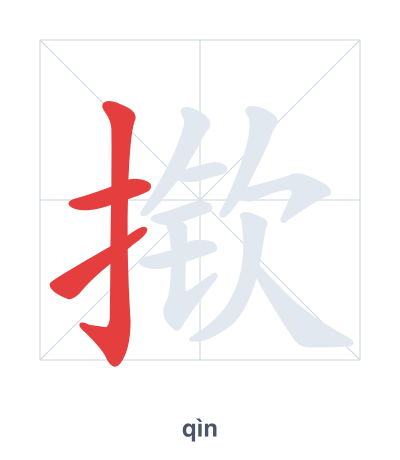
Open Hanzi Writer to see the animated stroke order and practice writing 揿 with real-time feedback.
The character 揿 (qìn) is written with 12 strokes. Follow the standard Chinese stroke order: top to bottom, left to right, outside before inside. The radical 扌 is one of its key components.
Practice the correct stroke order with the Hanzi Writer app to see animated stroke-by-stroke guidance with real-time feedback.
揿 means to press (with a finger).
揿 is a phono-semantic compound. The radical 扌 (hand) indicates the action is performed by hand. The phonetic component 钦 (qīn) hints at pronunciation; structurally it combines 金 (metal) above 欠 (to lack/yawn), suggesting the firmness of pressing a metal button or the idea of pressing until resistance yields.
💡 Memory Tip: Imagine your hand (扌) pressing a golden (金) button to shut someone's yawning mouth (欠) — that's 揿, to press.
我揿了三次门铃。
wǒ qìn le sān cì mén líng
I rang the doorbell three times.
请揿一下这个按钮。
qǐng qìn yī xià zhè ge àn niǔ
Please press this button.
用揿钉把画固定。
yòng qìn dīng bǎ huà gù dìng
Fix the painting with thumbtacks.
Open Hanzi Writer to see the animated stroke order and practice writing 揿 with real-time feedback.
✨ Animated stroke order · Handwriting recognition · HSK-graded practice · Free to use
The character 揿 consists of the left radical 扌 (hand) and the right part 钦 (qīn). The hand radical indicates the action is done with the hand, while 钦 provides the pronunciation qìn. Together, they form the meaning "to press with a finger."