钮 (niǔ) means "Button / Knob" in Chinese. It has 9 strokes with the radical 钅.
Rated 4/5 in difficulty (challenging).
Appears in 3+ common words including 按钮 (àn niǔ), 电梯按钮 (diàn tī àn niǔ), 旋钮 (xuán niǔ).
Due to its 9 strokes, Hanzi Writer's error detection shows 钮 requires focused practice — most learners need 10+ attempts for consistent accuracy.
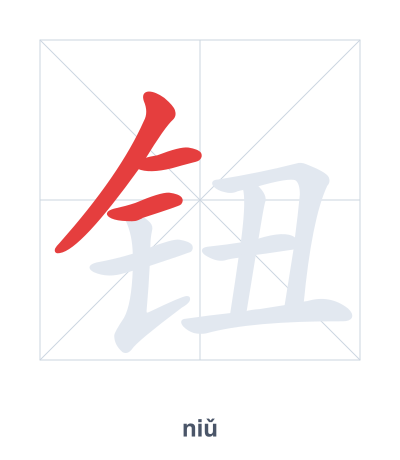
Open Hanzi Writer to see the animated stroke order and practice writing 钮 with real-time feedback.
The character 钮 (niǔ) is written with 9 strokes. Follow the standard Chinese stroke order: top to bottom, left to right, outside before inside. The radical 钅 is one of its key components.
Practice the correct stroke order with the Hanzi Writer app to see animated stroke-by-stroke guidance with real-time feedback.
钮 means Button / Knob.
钮 is a phono-semantic compound. The left part 钅 (metal) indicates it's made of metal, and the right part 丑 (niǔ here, unrelated to 'ugly') originally represented a twisted thread or bent hand, lending both sound and a subtle hint of twisting or turning—apt for a button or knob you twist to fasten.
💡 Memory Tip: Imagine a metal button with a tiny clown face (丑) on it, which you press to hear a loud 'NIǓ!' noise.
请按这个红色按钮。
qǐng àn zhè ge hóng sè àn niǔ
Please press this red button.
电梯按钮在左边。
diàn tī àn niǔ zài zuǒ biān
The elevator button is on the left.
转动这个旋钮调音量。
zhuǎn dòng zhè ge xuán niǔ tiáo yīn liàng
Turn this knob to adjust the volume.
Open Hanzi Writer to see the animated stroke order and practice writing 钮 with real-time feedback.
✨ Animated stroke order · Handwriting recognition · HSK-graded practice · Free to use
The left component 钅 is the metal radical, showing that 钮 is made of metal. The right component 丑 gives the character its pronunciation "niǔ" and acts as a phonetic element. Together they mean a metal button or knob, like an elevator button.