寝 (qǐn) means "To sleep; bedroom." in Chinese. It has 13 strokes with the radical 宀, and is HSK Level 7.
Rated 4.2/5 in difficulty (advanced).
Harder than 52% of HSK Level 7 characters.
Appears in 3+ common words including 寝室 (qǐn shì), 就寝 (jiù qǐn), 寝具 (qǐn jù).
Due to its 13 strokes, Hanzi Writer's error detection shows 寝 requires focused practice — most learners need 10+ attempts for consistent accuracy.
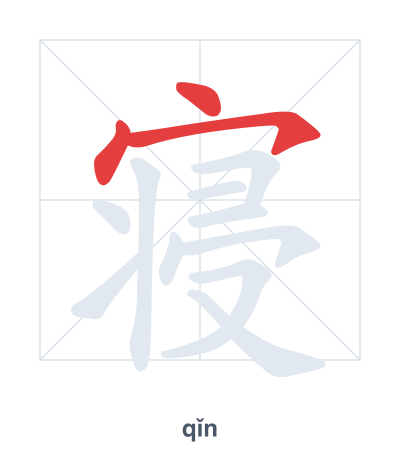
Open Hanzi Writer to see the animated stroke order and practice writing 寝 with real-time feedback.
The character 寝 (qǐn) is written with 13 strokes. Follow the standard Chinese stroke order: top to bottom, left to right, outside before inside. The radical 宀 is one of its key components.
Practice the correct stroke order with the Hanzi Writer app to see animated stroke-by-stroke guidance with real-time feedback.
寝 means To sleep; bedroom..
As an HSK Level 7 character, 寝 is an intermediate-level character.
寝 originally written as 寢 combines the roof radical 宀 with a person 亻 and a broom 帚, depicting someone sweeping their bedroom before sleeping.
💡 Memory Tip: Imagine a person (亻) under a roof (宀) using a broom (帚) to clean their bedroom before they sleep.
我的寝室很干净。
wǒ de qǐn shì hěn gān jìng
My dormitory room is very clean.
他已经就寝了。
tā yǐ jīng jiù qǐn le
He has already gone to bed.
这里的寝具很舒服。
zhè lǐ de qǐn jù hěn shū fú
The bedding here is very comfortable.
Open Hanzi Writer to see the animated stroke order and practice writing 寝 with real-time feedback.
✨ Animated stroke order · Handwriting recognition · HSK-graded practice · Free to use
The character 寝 combines the radical 宀 (roof) on top with the component 㑒 underneath. The roof symbol represents a building, while 㑒 shows a person lying down, together forming the image of a person sleeping under a roof. This structure directly conveys the meanings of "to sleep" and "bedroom."