具 (jù) means "Tool; to possess; to provide" in Chinese. It has 8 strokes with the radical 八, and is HSK Level 3.
Rated 3.4/5 in difficulty (challenging).
Harder than 35% of HSK Level 3 characters.
Appears in 3+ common words including 家具 (jiā jù), 玩具 (wán jù), 具体 (jù tǐ).
Due to its 8 strokes, Hanzi Writer's error detection shows 具 requires focused practice — most learners need 10+ attempts for consistent accuracy.
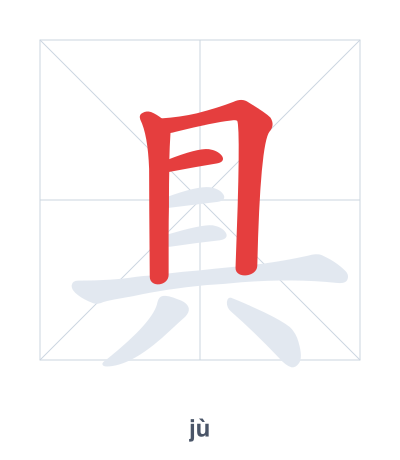
Open Hanzi Writer to see the animated stroke order and practice writing 具 with real-time feedback.
The character 具 (jù) is written with 8 strokes. Follow the standard Chinese stroke order: top to bottom, left to right, outside before inside. The radical 八 is one of its key components.
Practice the correct stroke order with the Hanzi Writer app to see animated stroke-by-stroke guidance with real-time feedback.
具 means Tool; to possess; to provide.
As an HSK Level 3 character, 具 is an intermediate-level character.
Ancient Chinese depicted this character as two hands (廾, later simplified to 八) holding a cauldron (鼎, later simplified to 目), representing the act of preparing or providing a meal. Over time, the meaning broadened to include any tool or possession, as the hands holding the vessel symbolize having something ready for use.
💡 Memory Tip: Picture an eyeball (目) sitting on two outstretched arms (八) — you need those arms to hold tools, and that eye to see what you possess.
这件家具很贵。
zhè jiàn jiā jù hěn guì
This piece of furniture is very expensive.
孩子喜欢玩具。
hái zi xǐ huān wán jù
Children like toys.
请说具体一点。
qǐng shuō jù tǐ yì diǎn
Please be more specific.
Open Hanzi Writer to see the animated stroke order and practice writing 具 with real-time feedback.
✨ Animated stroke order · Handwriting recognition · HSK-graded practice · Free to use
The character 具 consists of a top part (a variant of 目, meaning "eye") and a bottom part (廾, meaning "two hands"). This combination originally depicted an eye being watched by hands, suggesting the idea of "preparing" or "providing" something for inspection. Over time, it came to mean "tool" (something used to do work) and "to possess" (to have something ready).