钳 (qián) means "pliers / to clamp" in Chinese. It has 10 strokes with the radical 钅, and is HSK Level 7.
Rated 4.2/5 in difficulty (advanced).
Harder than 94% of HSK Level 7 characters.
Appears in 3+ common words including 钳子 (qián zi), 老虎钳 (lǎo hǔ qián), 钳住 (qián zhù).
Due to its 10 strokes, Hanzi Writer's error detection shows 钳 requires focused practice — most learners need 10+ attempts for consistent accuracy.
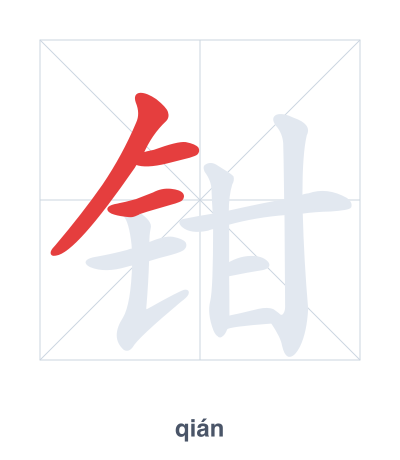
Open Hanzi Writer to see the animated stroke order and practice writing 钳 with real-time feedback.
The character 钳 (qián) is written with 10 strokes. Follow the standard Chinese stroke order: top to bottom, left to right, outside before inside. The radical 钅 is one of its key components.
Practice the correct stroke order with the Hanzi Writer app to see animated stroke-by-stroke guidance with real-time feedback.
钳 means pliers / to clamp.
As an HSK Level 7 character, 钳 is an intermediate-level character.
The character 钳 is a compound with the radical 钅 (metal) indicating it's a tool made of metal, and the component 甘 (qián) providing the pronunciation. Together, they represent metal pliers used for clamping or gripping objects.
💡 Memory Tip: Picture metal pliers (钅) clamping down on a sweet candy (甘) to hold it tight.
请给我一把钳子。
qǐng gěi wǒ yī bǎ qián zi
Please give me a pair of pliers.
老虎钳可以剪断铁丝。
lǎo hǔ qián kě yǐ jiǎn duàn tiě sī
Pliers can cut through iron wire.
螃蟹钳住了他的手指。
páng xiè qián zhù le tā de shǒu zhǐ
The crab pinched his finger.
Open Hanzi Writer to see the animated stroke order and practice writing 钳 with real-time feedback.
✨ Animated stroke order · Handwriting recognition · HSK-graded practice · Free to use
The left component is 钅, the metal radical, which indicates that pliers are made of metal. The right component is 甘, which originally acted as a phonetic hint, though its modern pronunciation (gān) differs from qián. Together, the character represents a metal tool used for gripping.