鲯 (qí) means "Mahi-mahi" in Chinese. It has 16 strokes with the radical 鱼.
Rated 4.2/5 in difficulty (advanced).
Appears in 3+ common words including 鲯鳅 (qí qiū), 钓鲯鳅 (diào qí qiū), 鲯鳅鱼 (qí qiū yú).
Due to its 16 strokes, Hanzi Writer's error detection shows 鲯 requires focused practice — most learners need 10+ attempts for consistent accuracy.
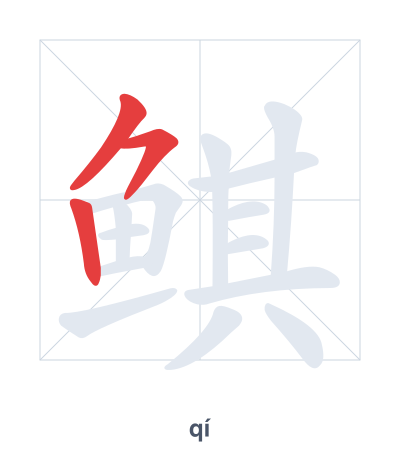
Open Hanzi Writer to see the animated stroke order and practice writing 鲯 with real-time feedback.
The character 鲯 (qí) is written with 16 strokes. Follow the standard Chinese stroke order: top to bottom, left to right, outside before inside. The radical 鱼 is one of its key components.
Practice the correct stroke order with the Hanzi Writer app to see animated stroke-by-stroke guidance with real-time feedback.
鲯 means Mahi-mahi.
鲯 is a phono-semantic compound: the left component 鱼 (fish) indicates the meaning, and the right component 其 (qí) provides the pronunciation. The character is used to denote the mahi-mahi, a brightly colored ocean fish.
💡 Memory Tip: Picture a fish (鱼) wearing a fancy basket (其) on its head, swimming gracefully like a mahi-mahi.
鲯鳅的颜色非常漂亮。
qí qiū de yán sè fēi cháng piào liàng
The color of mahi-mahi is very beautiful.
爸爸去海边钓鲯鳅。
bà bà qù hǎi biān diào qí qiū
Dad went to the seaside to fish for mahi-mahi.
鲯鳅鱼游得非常快。
qí qiū yú yóu dé fēi cháng kuài
Mahi-mahi fish swim very fast.
Open Hanzi Writer to see the animated stroke order and practice writing 鲯 with real-time feedback.
✨ Animated stroke order · Handwriting recognition · HSK-graded practice · Free to use
鲯 is a left-right character. The left part 鱼 (fish radical) indicates it is a type of fish. The right part 奇 (qí) provides the pronunciation and also means "strange" — together they suggest a fish with a strange or distinctive look, which fits the mahi-mahi's colorful appearance.