嘌 (piào) means "Purine (used in compounds)" in Chinese. It has 14 strokes with the radical 口.
Rated 4.2/5 in difficulty (advanced).
Appears in 3+ common words including 嘌呤 (piào líng), 嘌呤值 (piào líng zhí), 低嘌呤 (dī piào líng).
Due to its 14 strokes, Hanzi Writer's error detection shows 嘌 requires focused practice — most learners need 10+ attempts for consistent accuracy.
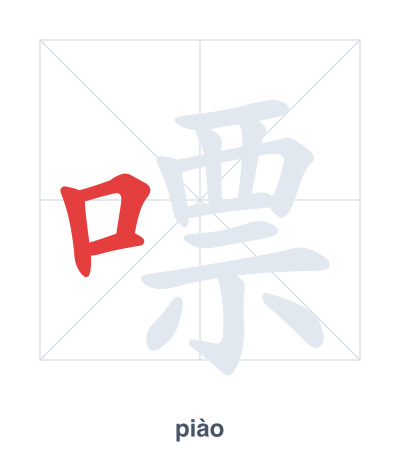
Open Hanzi Writer to see the animated stroke order and practice writing 嘌 with real-time feedback.
The character 嘌 (piào) is written with 14 strokes. Follow the standard Chinese stroke order: top to bottom, left to right, outside before inside. The radical 口 is one of its key components.
Practice the correct stroke order with the Hanzi Writer app to see animated stroke-by-stroke guidance with real-time feedback.
嘌 means Purine (used in compounds).
嘌 is a modern phono-semantic compound used to transliterate foreign chemical terms. The radical 口 ('mouth') indicates it represents a foreign sound, while 票 (piào, 'ticket') provides the approximate pronunciation. Together, they form the character for 'purine' in chemical terminology.
💡 Memory Tip: Picture a mouth (口) chomping on a ticket (票) that tastes like bitter purine chemicals.
这种食物嘌呤高。
zhè zhǒng shí wù piào líng gāo
This food is high in purines.
检查一下嘌呤值。
jiǎn chá yī xià piào líng zhí
Check the purine level.
我要吃低嘌呤食物。
wǒ yào chī dī piào líng shí wù
I need to eat low-purine foods.
Open Hanzi Writer to see the animated stroke order and practice writing 嘌 with real-time feedback.
✨ Animated stroke order · Handwriting recognition · HSK-graded practice · Free to use
The character 嘌 is made of the radical 口 (mouth) on the left and the phonetic component 票 (ticket, piào) on the right. The mouth radical does not contribute to the chemical meaning of 'purine'; instead, the whole character is used as a phonetic loan to represent the sound of the foreign word 'purine'.