低 (dī) means "low; to lower (one's head)" in Chinese. It has 7 strokes with the radical 亻, and is HSK Level 2.
Rated 2.7/5 in difficulty (moderate).
Harder than 25% of HSK Level 2 characters.
Appears in 3+ common words including 低头 (dī tóu), 高低 (gāo dī), 很低 (hěn dī).
Hanzi Writer's stroke validation shows learners typically need 5-8 attempts to write 低 with correct proportion and order.
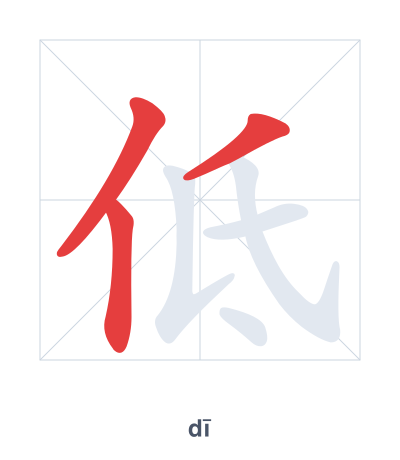
Open Hanzi Writer to see the animated stroke order and practice writing 低 with real-time feedback.
The character 低 (dī) is written with 7 strokes. Follow the standard Chinese stroke order: top to bottom, left to right, outside before inside. The radical 亻 is one of its key components.
Practice the correct stroke order with the Hanzi Writer app to see animated stroke-by-stroke guidance with real-time feedback.
低 means low; to lower (one's head).
As an HSK Level 2 character, 低 is among the first characters beginners learn.
The character 低 combines the radical 亻 (person) with 氐 (dǐ, meaning 'base' or 'foundation'), which also provides phonetic hints. A person (亻) lowering to the base (氐) visually represents being low or lowering one's head.
💡 Memory Tip: Picture a person (亻) bowing so deeply that their head touches the ground, represented by the bottom part 氐 looking like a base or foundation.
他低头看手机。
tā dī tóu kàn shǒu jī
He looked down at his phone.
这里的山高低不同。
zhè lǐ de shān gāo dī bù tóng
The mountains here vary in height.
那个桌子很低。
nà ge zhuō zi hěn dī
That table is very low.
Open Hanzi Writer to see the animated stroke order and practice writing 低 with real-time feedback.
✨ Animated stroke order · Handwriting recognition · HSK-graded practice · Free to use
低 is made of the radical 亻 (person) on the left and 氐 on the right. 氐 originally meant “low” or “base,” so together they show a person lowering or being low. This structure directly gives the character’s meanings of “low” and “to lower (one’s head).”