睥 (pì) means "To look askance." in Chinese. It has 13 strokes with the radical 目.
Rated 4.2/5 in difficulty (advanced).
Appears in 3+ common words including 睥睨 (pì nì), 睥睨一切 (pì nì yī qiè), 睥视 (pì shì).
Due to its 13 strokes, Hanzi Writer's error detection shows 睥 requires focused practice — most learners need 10+ attempts for consistent accuracy.
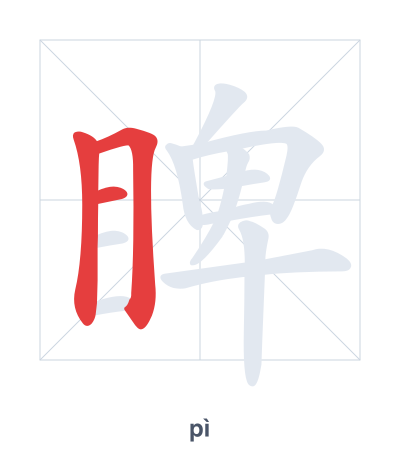
Open Hanzi Writer to see the animated stroke order and practice writing 睥 with real-time feedback.
The character 睥 (pì) is written with 13 strokes. Follow the standard Chinese stroke order: top to bottom, left to right, outside before inside. The radical 目 is one of its key components.
Practice the correct stroke order with the Hanzi Writer app to see animated stroke-by-stroke guidance with real-time feedback.
睥 means To look askance..
睥 is a compound character where the radical 目 (eye) on the left indicates the action of looking, while the right component 卑 (low, humble) provides phonetic cues and adds the nuance of looking down or sideways with disdain.
💡 Memory Tip: Imagine an eye (目) glaring sideways at a lowly person (卑) with a scornful side-eye.
他睥睨着对手。
tā pì nì zhe duì shǒu
He looked disdainfully at his opponent.
他睥睨一切。
tā pì nì yī qiè
He looks down on everything.
他睥视着前方。
tā pì shì zhe qián fāng
He looked ahead with disdain.
Open Hanzi Writer to see the animated stroke order and practice writing 睥 with real-time feedback.
✨ Animated stroke order · Handwriting recognition · HSK-graded practice · Free to use
睥 is made of the radical 目 (eye) on the left, and the component 卑 (humble or low) on the right. The combination suggests an "eye looking at something low" — which fits the meaning of looking askance, often with disdain.