切 (qiē/qiè) means "to cut" in Chinese. It has 4 strokes with the radical 刀, and is HSK Level 3.
Rated 2.4/5 in difficulty (moderate).
Harder than 6% of HSK Level 3 characters.
Appears in 4+ common words including 切开 (qiè kāi), 切割 (qiē gē), 急切 (jí qiè).
Hanzi Writer's stroke validation shows learners typically need 5-8 attempts to write 切 with correct proportion and order.
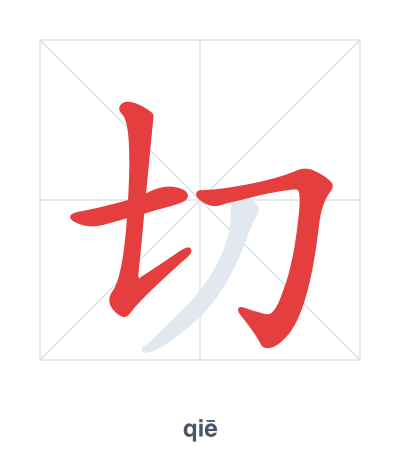
Open Hanzi Writer to see the animated stroke order and practice writing 切 with real-time feedback.
The character 切 (qiē/qiè) is written with 4 strokes. Follow the standard Chinese stroke order: top to bottom, left to right, outside before inside. The radical 刀 is one of its key components.
Practice the correct stroke order with the Hanzi Writer app to see animated stroke-by-stroke guidance with real-time feedback.
切 means to cut.
This is a polyphonic character with readings: qiē, qiè.
As an HSK Level 3 character, 切 is an intermediate-level character.
切 combines the radical 刀 (knife) with 七 (seven), which originally served as a phonetic component suggesting the sound 'qiē'. The character depicts the action of using a knife to divide something, linking the tool (刀) to the concept of cutting.
💡 Memory Tip: Imagine a knife (刀) slicing a cake into seven (七) equal pieces — that's 切, to cut.
妈妈把西瓜切开,分给屋子里的每一个人。
mā mā bǎ xī guā qiè kāi fēn gěi wū zi lǐ de měi yí gè rén
Mom cut the watermelon and shared it with everyone in the room.
工人正用激光切割机对钢板进行加工。
gōng rén zhèng yòng jī guāng qiē gē jī duì gāng bǎn jìn xíng jiā gōng
Workers are using a laser cutter to process steel plates.
他急切地想要知道考试的结果。
tā jí qiè dì xiǎng yào zhī dào kǎo shì de jié guǒ
He is eager to know the results of the exam.
我们必须制定出切实的计划来解决问题。
wǒ men bì xū zhì dìng chū qiè shí de jì huà lái jiě jué wèn tí
We must formulate a practical plan to solve the problem.
Open Hanzi Writer to see the animated stroke order and practice writing 切 with real-time feedback.
✨ Animated stroke order · Handwriting recognition · HSK-graded practice · Free to use
The character 切 is made of two parts: the left side 七 (qī, meaning seven) and the right side 刀 (dāo, meaning knife). The 刀 radical directly shows that the character involves a knife, while 七 provides a phonetic clue (though the pronunciation is not exactly the same). Together, they create the idea of using a knife to cut something.