擗 (pǐ) means "to break off; to split open" in Chinese. It has 16 strokes with the radical 扌.
Rated 4.2/5 in difficulty (advanced).
Appears in 3+ common words including 擗开 (pǐ kāi), 擗玉米 (pǐ yù mǐ), 擗断 (pǐ duàn).
Due to its 16 strokes, Hanzi Writer's error detection shows 擗 requires focused practice — most learners need 10+ attempts for consistent accuracy.
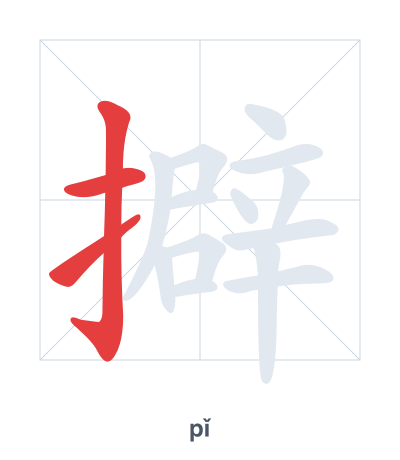
Open Hanzi Writer to see the animated stroke order and practice writing 擗 with real-time feedback.
The character 擗 (pǐ) is written with 16 strokes. Follow the standard Chinese stroke order: top to bottom, left to right, outside before inside. The radical 扌 is one of its key components.
Practice the correct stroke order with the Hanzi Writer app to see animated stroke-by-stroke guidance with real-time feedback.
擗 means to break off; to split open.
This compound character combines the hand radical 扌 (hand) with the phonetic component 辟 (pì), which originally depicted a kneeling person before a knife (symbolizing punishment or separation). The hand radical indicates the action of manually breaking or splitting something apart, like snapping a branch or opening a crack.
💡 Memory Tip: Picture your hand (扌) grabbing a stubborn stick and with a sharp twist, you split it open—the crack sounds like 'pǐ' as it breaks apart.
他把面包擗开了。
tā bǎ miàn bāo pǐ kāi le
He broke the bread apart.
农民在田里擗玉米。
nóng mín zài tián lǐ pǐ yù mǐ
Farmers are picking corn in the field.
他把树枝擗断了。
tā bǎ shù zhī pǐ duàn le
He broke off the tree branch.
Open Hanzi Writer to see the animated stroke order and practice writing 擗 with real-time feedback.
✨ Animated stroke order · Handwriting recognition · HSK-graded practice · Free to use
擗 is composed of the hand radical 扌 on the left and 辟 on the right. The hand radical indicates the action is performed by hand, while 辟 carries the idea of opening or splitting. Together they form the meaning of breaking off or splitting open something with your hands.