哌 (pài) means "(used in chemical names like piperidine)" in Chinese. It has 9 strokes with the radical 口.
Rated 4/5 in difficulty (challenging).
Appears in 3+ common words including 哌哌 (pài pài), 哌啶 (pài dìng), 哌替啶 (pài tì dìng).
Due to its 9 strokes, Hanzi Writer's error detection shows 哌 requires focused practice — most learners need 10+ attempts for consistent accuracy.
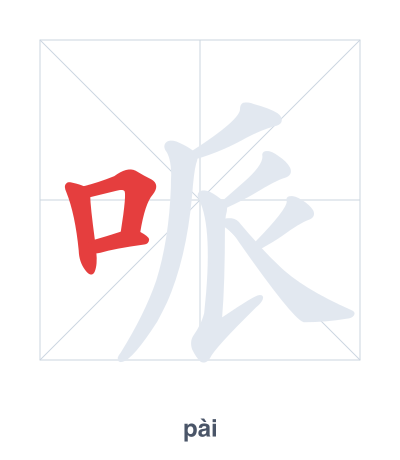
Open Hanzi Writer to see the animated stroke order and practice writing 哌 with real-time feedback.
The character 哌 (pài) is written with 9 strokes. Follow the standard Chinese stroke order: top to bottom, left to right, outside before inside. The radical 口 is one of its key components.
Practice the correct stroke order with the Hanzi Writer app to see animated stroke-by-stroke guidance with real-time feedback.
哌 means (used in chemical names like piperidine).
哌 is a modern phono-semantic compound, with the mouth radical 口 indicating it's a phonetic loan character for transliterating foreign chemical terms, and 派 (pài) providing the pronunciation. It has no ancient form, as it was created for modern scientific vocabulary like piperidine.
💡 Memory Tip: Picture a mouth (口) saying 'pai' while holding a chemical flask labeled 'piperidine' in a science faction (派).
鸭子哌哌叫。
yā zi pài pài jiào
The duck quacks.
这是哌啶。
zhè shì pài dìng
This is piperidine.
医生用了哌替啶。
yī shēng yòng le pài tì dìng
The doctor used pethidine.
Open Hanzi Writer to see the animated stroke order and practice writing 哌 with real-time feedback.
✨ Animated stroke order · Handwriting recognition · HSK-graded practice · Free to use
哌 is made of the radical 口 (mouth) on the left and 巿 (fú) on the right. The 口 radical suggests that the character is used to represent a sound or foreign word, while 巿 gives the pronunciation pài. This structure is common for characters used in chemical transliterations.