懦 (nuò) means "cowardly; weak" in Chinese. It has 17 strokes with the radical 忄.
Rated 4.2/5 in difficulty (advanced).
Appears in 3+ common words including 懦弱 (nuò ruò), 懦夫 (nuò fū), 怯懦 (qiè nuò).
Due to its 17 strokes, Hanzi Writer's error detection shows 懦 requires focused practice — most learners need 10+ attempts for consistent accuracy.
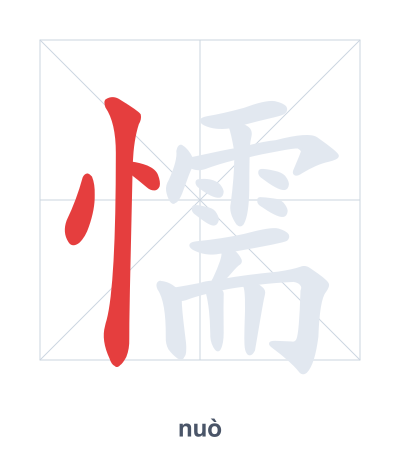
Open Hanzi Writer to see the animated stroke order and practice writing 懦 with real-time feedback.
The character 懦 (nuò) is written with 17 strokes. Follow the standard Chinese stroke order: top to bottom, left to right, outside before inside. The radical 忄 is one of its key components.
Practice the correct stroke order with the Hanzi Writer app to see animated stroke-by-stroke guidance with real-time feedback.
懦 means cowardly; weak.
The character 懦 combines the heart radical (忄), indicating emotion, with 需 (xū), which originally showed a person getting wet in rain, symbolizing softness and hesitation. Together, they depict a heart that is weak, timid, and easily overwhelmed, like someone lacking courage in the face of adversity.
💡 Memory Tip: Picture a cowardly heart (忄) needing (需) an umbrella because it's too weak to face even a gentle rain.
他性格很懦弱。
tā xìng gé hěn nuò ruò
He has a weak personality.
他不是一个懦夫。
tā bú shì yí gè nuò fū
He is not a coward.
别表现得太怯懦。
bié biǎo xiàn dé tài qiè nuò
Don't act too cowardly.
Open Hanzi Writer to see the animated stroke order and practice writing 懦 with real-time feedback.
✨ Animated stroke order · Handwriting recognition · HSK-graded practice · Free to use
懦 has the heart radical 忄 on the left, showing this word relates to emotions or inner state. The right side is 需 (xū, 'need'), which gives a pronunciation hint and suggests a weak heart that 'needs' support. Together, they create the idea of a cowardly or weak-willed person.