憎 (zēng) means "to hate; to detest" in Chinese. It has 15 strokes with the radical 忄.
Rated 4.2/5 in difficulty (advanced).
Appears in 3+ common words including 憎恨 (zēng hèn), 憎恶 (zēng wù), 爱憎分明 (ài zēng fēn míng).
Due to its 15 strokes, Hanzi Writer's error detection shows 憎 requires focused practice — most learners need 10+ attempts for consistent accuracy.
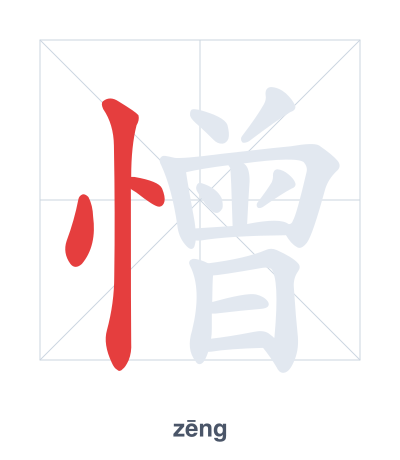
Open Hanzi Writer to see the animated stroke order and practice writing 憎 with real-time feedback.
The character 憎 (zēng) is written with 15 strokes. Follow the standard Chinese stroke order: top to bottom, left to right, outside before inside. The radical 忄 is one of its key components.
Practice the correct stroke order with the Hanzi Writer app to see animated stroke-by-stroke guidance with real-time feedback.
憎 means to hate; to detest.
The character 憎 consists of the radical 忄 (heart) on the left, indicating emotion, and the phonetic component 曾 (zēng) on the right, which provides the sound. The heart radical shows that this character relates to feelings, and 曾 originally meant 'once' but here contributes to the pronunciation, not the meaning.
💡 Memory Tip: Imagine your heart (忄) feeling heavy and twisted like a '曾' (a tangled rope) when you see something you hate.
我们憎恨战争。
wǒ men zēng hèn zhàn zhēng
We hate war.
他憎恶说谎的人。
tā zēng wù shuō huǎng de rén
He detests liars.
他是一个爱憎分明的人。
tā shì yí gè ài zēng fēn míng de rén
He is a person with a clear sense of what to love and what to hate.
Open Hanzi Writer to see the animated stroke order and practice writing 憎 with real-time feedback.
✨ Animated stroke order · Handwriting recognition · HSK-graded practice · Free to use
The character 憎 has two parts: the left side is 忄 (heart), which shows that the word is about emotions, and the right side is 曾, which gives the sound 'zēng'. The heart radical tells you that hating is a feeling from the heart, while 曾 is just a phonetic clue, so the structure helps you remember both the meaning and the pronunciation.