愍 (mǐn) means "to pity" in Chinese. It has 13 strokes with the radical 心.
Rated 4.2/5 in difficulty (advanced).
Appears in 3+ common words including 哀愍 (āi mǐn), 怜愍 (lián mǐn), 愍念 (mǐn niàn).
Due to its 13 strokes, Hanzi Writer's error detection shows 愍 requires focused practice — most learners need 10+ attempts for consistent accuracy.
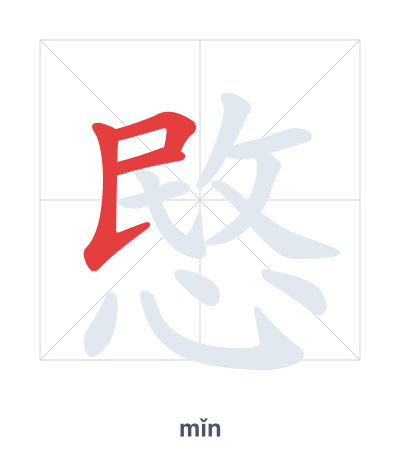
Open Hanzi Writer to see the animated stroke order and practice writing 愍 with real-time feedback.
The character 愍 (mǐn) is written with 13 strokes. Follow the standard Chinese stroke order: top to bottom, left to right, outside before inside. The radical 心 is one of its key components.
Practice the correct stroke order with the Hanzi Writer app to see animated stroke-by-stroke guidance with real-time feedback.
愍 means to pity.
愍 combines 心 (heart) as the semantic radical with 敃 (mǐn, meaning 'urgent' or 'quick') as a phonetic component, suggesting a heart that swiftly feels compassion or pity. The upper part 敃 itself is formed from 民 (people) and 攵 (a hand with a stick), hinting at a situation where people are harmed, evoking pity in the heart.
💡 Memory Tip: Picture a heart (心) seeing people (民) being struck by a hand (攵) and instantly feeling pity.
这种行为令人哀愍。
zhè zhǒng xíng wéi lìng rén āi mǐn
This behavior is pitiable.
他有一颗怜愍之心。
tā yǒu yī kē lián mǐn zhī xīn
He has a compassionate heart.
我们要愍念弱者。
wǒ men yào mǐn niàn ruò zhě
We should show sympathy for the weak.
Open Hanzi Writer to see the animated stroke order and practice writing 愍 with real-time feedback.
✨ Animated stroke order · Handwriting recognition · HSK-graded practice · Free to use
愍 is made of 民 (mín, people) on top and 心 (xīn, heart) below. The idea is that the heart feels for the people, which connects to the meaning of pity or compassion.