氓 (máng) means "Hoodlum / Rogue" in Chinese. It has 8 strokes with the radical 氏, and is HSK Level 7.
Rated 3.3/5 in difficulty (challenging).
Harder than 12% of HSK Level 7 characters.
Appears in 3+ common words including 流氓 (liú máng), 氓隶 (máng lì), 黎氓 (lí máng).
Due to its 8 strokes, Hanzi Writer's error detection shows 氓 requires focused practice — most learners need 10+ attempts for consistent accuracy.
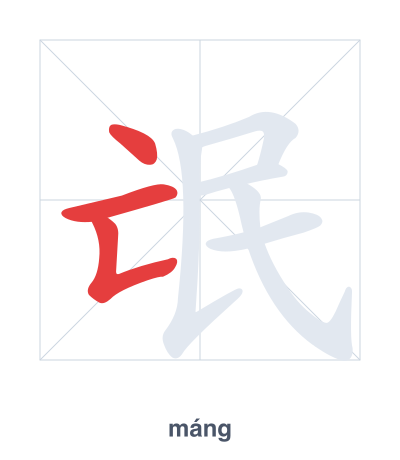
Open Hanzi Writer to see the animated stroke order and practice writing 氓 with real-time feedback.
The character 氓 (máng) is written with 8 strokes. Follow the standard Chinese stroke order: top to bottom, left to right, outside before inside. The radical 氏 is one of its key components.
Practice the correct stroke order with the Hanzi Writer app to see animated stroke-by-stroke guidance with real-time feedback.
氓 means Hoodlum / Rogue.
As an HSK Level 7 character, 氓 is an intermediate-level character.
The character 氓 combines the radical 氏 (clan) with 亡 (death/destroy), originally depicting a person whose clan has been lost or destroyed—hence a wandering commoner. Over time, this evolved to mean a homeless vagabond or rogue, someone detached from social order.
💡 Memory Tip: A hoodlum (氓) is a clan (氏) member who has 'died' (亡) to society, roaming as an outlaw.
他是个流氓。
tā shì gè liú máng
He is a hooligan.
古代有很多氓隶。
gǔ dài yǒu hěn duō máng lì
There were many commoners and slaves in ancient times.
黎氓生活很辛苦。
lí máng shēng huó hěn xīn kǔ
The lives of the common people were very difficult.
Open Hanzi Writer to see the animated stroke order and practice writing 氓 with real-time feedback.
✨ Animated stroke order · Handwriting recognition · HSK-graded practice · Free to use
The character 氓 is composed of 亡 (wáng, meaning 'to die' or 'to flee') on top and 民 (mín, meaning 'people') on the bottom. This combination originally suggested 'people who have fled' or 'lost people', which later evolved to mean a rogue or hoodlum.