Hanzi Writer

How to Write 蟒 (mǎng) — Meaning “Python”

mǎng 16 strokes Radical: 虫

蟒 (mǎng) means "Python" in Chinese. It has 16 strokes with the radical 虫.

Rated 4.2/5 in difficulty (advanced).

Appears in 3+ common words including 蟒蛇 (mǎng shé), 大蟒 (dà mǎng), 蟒袍 (mǎng páo).

Due to its 16 strokes, Hanzi Writer's error detection shows 蟒 requires focused practice — most learners need 10+ attempts for consistent accuracy.
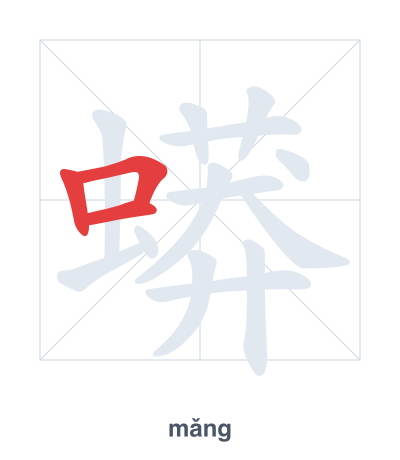
Stroke order practice for 蟒 - mǎng

Practice Writing 蟒 (mǎng)

Open Hanzi Writer to see the animated stroke order and practice writing 蟒 with real-time feedback.

The character (mǎng) is written with 16 strokes. Follow the standard Chinese stroke order: top to bottom, left to right, outside before inside. The radical is one of its key components.

Practice the correct stroke order with the Hanzi Writer app to see animated stroke-by-stroke guidance with real-time feedback.

means Python.

Character
Pinyinmǎng (mang)
MeaningPython
Strokes16
Radical
Difficulty4.2/5

蟒 combines the radical 虫 (insect/reptile) with 莽 (thick grass). 莽 originally depicted a dog (犬) in tall grass, symbolizing a wild, overgrown area where pythons hide. Together they represent a python, a large snake that dwells in dense vegetation.

💡 Memory Tip: Imagine a python (虫) coiled in a messy thicket of grass (艹) with a dog's head (犬) peeking out—that 莽 side is the python's tangled jungle home.

mǎng shé
Python
dà mǎng
Large python
mǎng páo
Dragon robe

动物园里有蟒蛇。

dòng wù yuán lǐ yǒu mǎng shé

There are pythons in the zoo.

这是一条大蟒。

zhè shì yī tiáo dà mǎng

This is a large python.

演员穿着蟒袍。

yǎn yuán chuān zhe mǎng páo

The actor is wearing a dragon robe.

Character Pinyin Strokes Radical
(current) mǎng 16
zhī 14
fēi 14
14
Stroke order practice for 蟒 - mǎng

Practice Writing 蟒 (mǎng)

Open Hanzi Writer to see the animated stroke order and practice writing 蟒 with real-time feedback.

✨ Animated stroke order · Handwriting recognition · HSK-graded practice · Free to use

Frequently Asked Questions about 蟒

蟒 combines the radical 虫 (insect/reptile) on the left with the phonetic component 莽 (mǎng, meaning thick grass) on the right. The 虫 radical indicates that 蟒 is a type of reptile or creature, while 莽 hints at its habitat in wild grass or its large, thick body.

Characters with Radical 虫

Other 16-Stroke Characters