螨 (mǎn) means "Mite" in Chinese. It has 16 strokes with the radical 虫.
Rated 4.2/5 in difficulty (advanced).
Appears in 3+ common words including 螨虫 (mǎn chóng), 除螨 (chú mǎn), 尘螨 (chén mǎn).
Due to its 16 strokes, Hanzi Writer's error detection shows 螨 requires focused practice — most learners need 10+ attempts for consistent accuracy.
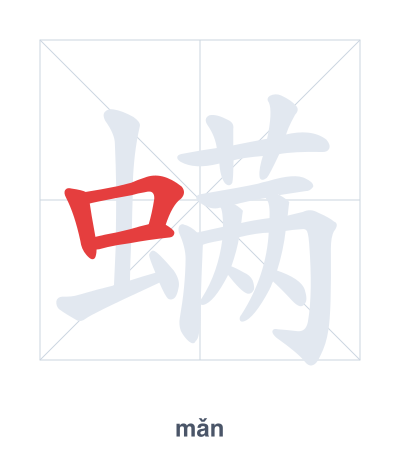
Open Hanzi Writer to see the animated stroke order and practice writing 螨 with real-time feedback.
The character 螨 (mǎn) is written with 16 strokes. Follow the standard Chinese stroke order: top to bottom, left to right, outside before inside. The radical 虫 is one of its key components.
Practice the correct stroke order with the Hanzi Writer app to see animated stroke-by-stroke guidance with real-time feedback.
螨 means Mite.
Mite (螨) is a phono-semantic compound. The radical 虫 (insect) indicates it belongs to the category of small arthropods, while 满 (mǎn, meaning 'full') provides the pronunciation. Together, the character represents a tiny creature that can become full of blood, like a mite feeding.
💡 Memory Tip: Picture a tiny insect (虫) that gets so full (满) of blood it becomes a bloated mite.
枕头上有螨虫。
zhěn tou shàng yǒu mǎn chóng
There are mites on the pillow.
我买了除螨喷雾。
wǒ mǎi le chú mǎn pēn wù
I bought anti-mite spray.
尘螨会引起过敏。
chén mǎn huì yǐn qǐ guò mǐn
Dust mites can cause allergies.
Open Hanzi Writer to see the animated stroke order and practice writing 螨 with real-time feedback.
✨ Animated stroke order · Handwriting recognition · HSK-graded practice · Free to use
螨 is composed of the radical 虫 (insect) on the left and the phonetic component 㒼 (mǎn, meaning 'full' or 'cover') on the right. The 虫 radical indicates that the character refers to a type of insect-like creature, specifically a mite. The right part gives a clue to its pronunciation, mǎn.