褛 (lǚ) means "tattered; ragged" in Chinese. It has 14 strokes with the radical 衤.
Rated 4.2/5 in difficulty (advanced).
Appears in 3+ common words including 褴褛 (lán lǚ), 衣衫褴褛 (yī shān lán lǚ), 破褛 (pò lǚ).
Due to its 14 strokes, Hanzi Writer's error detection shows 褛 requires focused practice — most learners need 10+ attempts for consistent accuracy.
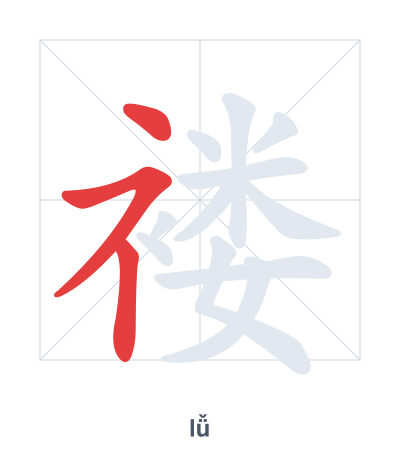
Open Hanzi Writer to see the animated stroke order and practice writing 褛 with real-time feedback.
The character 褛 (lǚ) is written with 14 strokes. Follow the standard Chinese stroke order: top to bottom, left to right, outside before inside. The radical 衤 is one of its key components.
Practice the correct stroke order with the Hanzi Writer app to see animated stroke-by-stroke guidance with real-time feedback.
褛 means tattered; ragged.
褛 is a phono-semantic compound. The left side 衤 (clothing radical) indicates the character relates to garments. The right side 娄 (lóu, originally meaning 'to drag' or 'frequent') provides pronunciation and suggests clothing that is dragged and worn, resulting in a tattered state.
💡 Memory Tip: Picture a ragged coat (衤) with a giant hole shaped like the tangled character 娄, as if the fabric has been dragged through the mud.
他的衣服很褴褛。
tā de yī fú hěn lán lǚ
His clothes are in tatters.
那个人衣衫褴褛。
nà ge rén yī shān lán lǚ
That person is dressed in rags.
他穿着一件破褛。
tā chuān zhe yī jiàn pò lǚ
He is wearing ragged clothes.
Open Hanzi Writer to see the animated stroke order and practice writing 褛 with real-time feedback.
✨ Animated stroke order · Handwriting recognition · HSK-graded practice · Free to use
褛 is composed of the radical 衤 (clothing) on the left, indicating the meaning is related to clothes, and the phonetic component 娄 (lóu) on the right, which hints at the pronunciation lǚ. Together, they form a character that specifically describes ragged or torn clothing.