褴 (lán) means "ragged; tattered" in Chinese. It has 15 strokes with the radical 衤.
Rated 4.2/5 in difficulty (advanced).
Appears in 3+ common words including 褴褛 (lán lǚ), 破褴 (pò lán), 褴褛衣 (lán lǚ yī).
Due to its 15 strokes, Hanzi Writer's error detection shows 褴 requires focused practice — most learners need 10+ attempts for consistent accuracy.
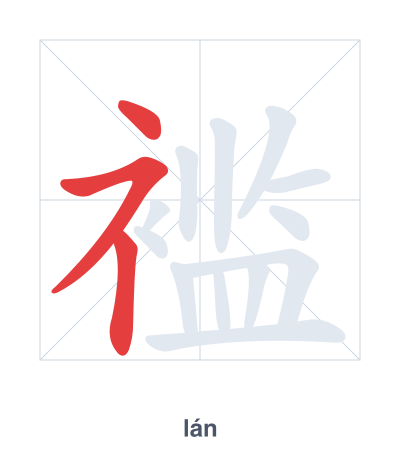
Open Hanzi Writer to see the animated stroke order and practice writing 褴 with real-time feedback.
The character 褴 (lán) is written with 15 strokes. Follow the standard Chinese stroke order: top to bottom, left to right, outside before inside. The radical 衤 is one of its key components.
Practice the correct stroke order with the Hanzi Writer app to see animated stroke-by-stroke guidance with real-time feedback.
褴 means ragged; tattered.
褴 combines the clothing radical 衤 (yī) with 监 (jiān), which provides the sound. It specifically refers to ragged or tattered garments, often used in the compound 褴褛 (lánlǚ) meaning 'shabby clothes'.
💡 Memory Tip: Picture a supervisor (监) whose only clothes (衤) are so tattered and ragged that he looks like a beggar.
他穿着褴褛的衣服。
tā chuān zhe lán lǚ de yī fú
He is wearing ragged clothes.
地上有一堆破褴。
dì shàng yǒu yī duī pò lán
There is a pile of rags on the ground.
这件褴褛衣很旧了。
zhè jiàn lán lǚ yī hěn jiù le
These ragged clothes are very old.
Open Hanzi Writer to see the animated stroke order and practice writing 褴 with real-time feedback.
✨ Animated stroke order · Handwriting recognition · HSK-graded practice · Free to use
褴 is composed of the radical 衤 on the left, which means "clothing," and the component 监 on the right, which provides a rough pronunciation hint (lán). The clothing radical directly connects to the meaning of ragged or tattered clothes, while the right side does not add meaning but helps with the sound.