裎 (chéng) means "To strip; nakedness (archaic)" in Chinese. It has 12 strokes with the radical 衤.
Rated 4.2/5 in difficulty (advanced).
Appears in 3+ common words including 裸裎 (luǒ chéng), 裎露 (chéng lù), 裎褐 (chéng hè).
Due to its 12 strokes, Hanzi Writer's error detection shows 裎 requires focused practice — most learners need 10+ attempts for consistent accuracy.
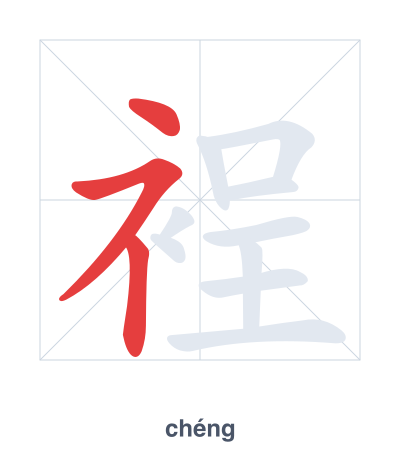
Open Hanzi Writer to see the animated stroke order and practice writing 裎 with real-time feedback.
The character 裎 (chéng) is written with 12 strokes. Follow the standard Chinese stroke order: top to bottom, left to right, outside before inside. The radical 衤 is one of its key components.
Practice the correct stroke order with the Hanzi Writer app to see animated stroke-by-stroke guidance with real-time feedback.
裎 means To strip; nakedness (archaic).
This compound character combines the clothing radical 衤 with 呈 (chéng, meaning 'to present' or 'to appear'). Together, they suggest 'presenting the body' by removing clothes, hence the meaning of stripping or nakedness.
💡 Memory Tip: Picture a person (呈) shedding their coat (衤) to stand completely bare—they are 'presenting' their naked self.
他们在河边裸裎相对。
tā men zài hé biān luǒ chéng xiāng duì
They are naked together by the river.
这种行为叫作裎露。
zhè zhǒng xíng wéi jiào zuò chéng lù
This behavior is called indecent exposure.
裎褐是古人的装束。
chéng hè shì gǔ rén de zhuāng shù
Coarse cloth garments were the attire of ancient people.
Open Hanzi Writer to see the animated stroke order and practice writing 裎 with real-time feedback.
✨ Animated stroke order · Handwriting recognition · HSK-graded practice · Free to use
裎 is made of the radical 衤 (clothing) on the left and the phonetic component 呈 (chéng) on the right. The clothing radical hints at the character's original connection to garments, while the meaning "to strip" or "nakedness" derives from removing clothes. Together, the structure suggests exposing the body by taking off clothing.