猡 (luó) means "pig; swine" in Chinese. It has 11 strokes with the radical 犭.
Rated 4.2/5 in difficulty (advanced).
Appears in 3+ common words including 猪猡 (zhū luó), 猡猡 (luó luó), 猡猡族 (luó luó zú).
Due to its 11 strokes, Hanzi Writer's error detection shows 猡 requires focused practice — most learners need 10+ attempts for consistent accuracy.
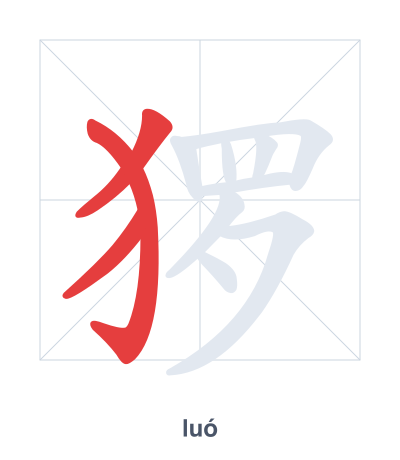
Open Hanzi Writer to see the animated stroke order and practice writing 猡 with real-time feedback.
The character 猡 (luó) is written with 11 strokes. Follow the standard Chinese stroke order: top to bottom, left to right, outside before inside. The radical 犭 is one of its key components.
Practice the correct stroke order with the Hanzi Writer app to see animated stroke-by-stroke guidance with real-time feedback.
猡 means pig; swine.
This compound character uses the animal radical 犭 (which originally depicted a dog) to classify meaning, and 罗 (luó, 'net' or 'to catch') as a phonetic and semantic component. The combination suggests a pig that is caught or kept in a net, tying to the meaning of 'pig' or 'swine' in certain dialects.
💡 Memory Tip: Imagine a silly pig tangled in a net (罗), with the animal radical (犭) representing the pig's body struggling to escape.
他生气地骂那人是猪猡。
tā shēng qì dì mà nà rén shì zhū luó
He angrily called that person a pig.
猡猡是以前的一种称呼。
luó luó shì yǐ qián de yī zhǒng chēng hū
'Luoluo' is an old term used in the past.
猡猡族是一个少数民族。
luó luó zú shì yí gè shǎo shù mín zú
The Lolo people are an ethnic minority.
Open Hanzi Writer to see the animated stroke order and practice writing 猡 with real-time feedback.
✨ Animated stroke order · Handwriting recognition · HSK-graded practice · Free to use
The left component 犭 is the animal radical, often used for beasts or hunting. The right component 罗 provides the pronunciation (luó). Together, 猡 means 'pig' or 'swine', as the radical hints at an animal.