鹿 (lù) means "Deer" in Chinese. It has 11 strokes with the radical 鹿, and is HSK Level 7.
Rated 3.9/5 in difficulty (challenging).
Harder than 38% of HSK Level 7 characters.
Appears in 3+ common words including 小鹿 (xiǎo lù), 梅花鹿 (méi huā lù), 鹿角 (lù jiǎo).
Due to its 11 strokes, Hanzi Writer's error detection shows 鹿 requires focused practice — most learners need 10+ attempts for consistent accuracy.
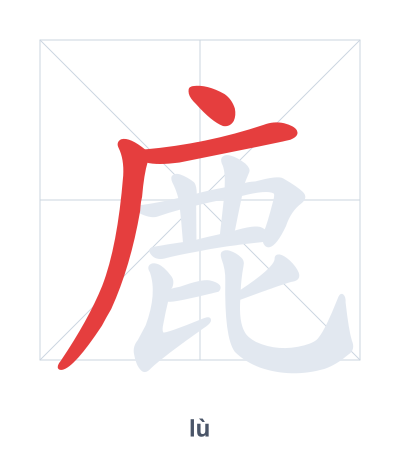
Open Hanzi Writer to see the animated stroke order and practice writing 鹿 with real-time feedback.
The character 鹿 (lù) is written with 11 strokes. Follow the standard Chinese stroke order: top to bottom, left to right, outside before inside. The radical 鹿 is one of its key components.
Practice the correct stroke order with the Hanzi Writer app to see animated stroke-by-stroke guidance with real-time feedback.
鹿 means Deer.
As an HSK Level 7 character, 鹿 is an intermediate-level character.
鹿 is a pictograph that in its ancient oracle bone script forms clearly depicted a deer with branching antlers, a slender body, and four legs. Over time, the character simplified but still retains the general silhouette of a deer facing left, with the top strokes representing the antlers and the lower parts the body and legs.
💡 Memory Tip: Imagine the top of 鹿 as a pair of antlers, the box-like part as the deer's head, and the bottom strokes as its swift legs running through the forest.
森林里有一只小鹿。
sēn lín lǐ yǒu yī zhī xiǎo lù
There is a little deer in the forest.
梅花鹿身上有斑点。
méi huā lù shēn shàng yǒu bān diǎn
Sika deer have spots on their bodies.
雄鹿长着漂亮的鹿角。
xióng lù zhǎng zhe piào liàng de lù jiǎo
The buck has beautiful antlers.
Open Hanzi Writer to see the animated stroke order and practice writing 鹿 with real-time feedback.
✨ Animated stroke order · Handwriting recognition · HSK-graded practice · Free to use
The character 鹿 is a pictograph that originally depicted a deer with antlers, a body, and legs. The top part (广) resembles the antlers, while the lower parts show the body and tail. Over time, the shape simplified, but the overall form still suggests a standing deer.