麈 (zhǔ) means "Large deer / Fly-whisk" in Chinese. It has 16 strokes with the radical 鹿.
Rated 4.2/5 in difficulty (advanced).
Appears in 3+ common words including 麈尾 (zhǔ wěi), 麈谈 (zhǔ tán), 拂麈 (fú zhǔ).
Due to its 16 strokes, Hanzi Writer's error detection shows 麈 requires focused practice — most learners need 10+ attempts for consistent accuracy.
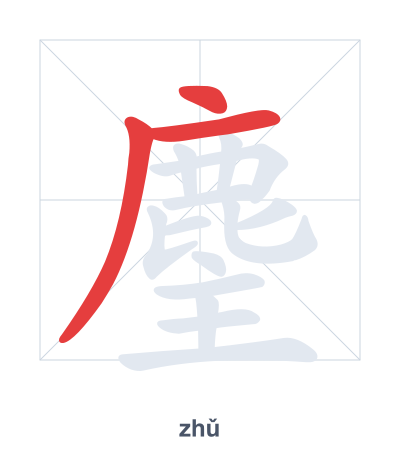
Open Hanzi Writer to see the animated stroke order and practice writing 麈 with real-time feedback.
The character 麈 (zhǔ) is written with 16 strokes. Follow the standard Chinese stroke order: top to bottom, left to right, outside before inside. The radical 鹿 is one of its key components.
Practice the correct stroke order with the Hanzi Writer app to see animated stroke-by-stroke guidance with real-time feedback.
麈 means Large deer / Fly-whisk.
| Character | 麈 |
| Pinyin | zhǔ (zhu) |
| Meaning | Large deer / Fly-whisk |
| Strokes | 16 |
| Radical | 鹿 |
| Difficulty | 4.2/5 |
麈 is a compound character with 鹿 (deer) as the radical and 主 (master) as a phonetic component. It originally referred to a large deer, likely the elk or moose, whose tail was used to make a ceremonial fly-whisk. Over time, the character came to represent the fly-whisk itself, a symbol of authority held by scholars and Daoist sages.
💡 Memory Tip: Imagine a majestic deer (鹿) serving as the 'master' (主) of the court, swishing its tail like a fly-whisk to command respect.
他拿着一把麈尾。
tā ná zhe yī bǎ zhǔ wěi
He was holding a fly-whisk.
这里的麈谈很有趣。
zhè lǐ de zhǔ tán hěn yǒu qù
The intellectual conversation here is very interesting.
他用拂麈打扫灰尘。
tā yòng fú zhǔ dǎ sǎo huī chén
He used a whisk to dust.
Open Hanzi Writer to see the animated stroke order and practice writing 麈 with real-time feedback.
✨ Animated stroke order · Handwriting recognition · HSK-graded practice · Free to use
麈 combines the radical 鹿 (deer) on top with the phonetic component 主 (zhǔ) below. The radical gives the general meaning of a type of deer, while 主 hints at the pronunciation. This structure indicates that 麈 originally referred to a large deer, and later came to mean a fly-whisk made from its tail.