凌 (líng) means "ice; to approach; to insult" in Chinese. It has 10 strokes with the radical 冫, and is HSK Level 7.
Rated 3.9/5 in difficulty (challenging).
Harder than 34% of HSK Level 7 characters.
Appears in 3+ common words including 凌晨 (líng chén), 欺凌 (qī líng), 冰凌 (bīng líng).
Due to its 10 strokes, Hanzi Writer's error detection shows 凌 requires focused practice — most learners need 10+ attempts for consistent accuracy.
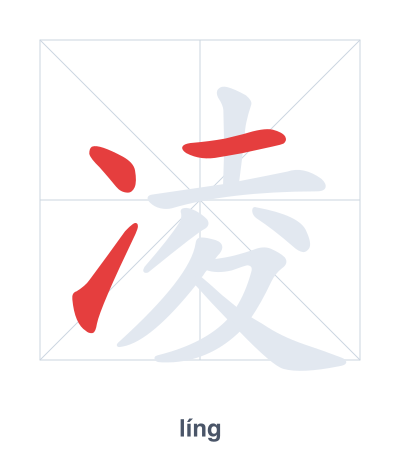
Open Hanzi Writer to see the animated stroke order and practice writing 凌 with real-time feedback.
The character 凌 (líng) is written with 10 strokes. Follow the standard Chinese stroke order: top to bottom, left to right, outside before inside. The radical 冫 is one of its key components.
Practice the correct stroke order with the Hanzi Writer app to see animated stroke-by-stroke guidance with real-time feedback.
凌 means ice; to approach; to insult.
As an HSK Level 7 character, 凌 is an intermediate-level character.
凌 combines the ice radical 冫 (two dots from an ancient ice crystal pictograph) with 夌 (líng), a phonetic component that originally depicted a person climbing or exceeding. Together, they convey ice that rises up or approaches, leading to the extended meanings of 'approach' and 'insult' (as in 'trample over' or 'exceed boundaries').
💡 Memory Tip: Imagine a person (夌 with its legs like a runner) skidding on a patch of ice (冫) and angrily approaching you to insult you.
我凌晨三点才睡觉。
wǒ líng chén sān diǎn cái shuì jiào
I didn't go to sleep until three in the morning.
我们不应该欺凌弱小。
wǒ men bù yīng gāi qī líng ruò xiǎo
We should not bully the weak.
房檐上挂着冰凌。
fáng yán shàng guà zhe bīng líng
Icicles are hanging from the eaves.
Open Hanzi Writer to see the animated stroke order and practice writing 凌 with real-time feedback.
✨ Animated stroke order · Handwriting recognition · HSK-graded practice · Free to use
凌 has two parts: the left radical 冫 (ice) and the right component 夌 (líng). The ice radical gives the meanings related to ice, like "icicle" (冰凌). The right part originally meant "to climb" or "to overstep," which connects to the meanings "to approach" and "to insult."