藉 (jí/jiè) means "By means of / To rely on" in Chinese. It has 17 strokes with the radical 艹.
Rated 4.2/5 in difficulty (advanced).
Appears in 4+ common words including 慰藉 (wèi jiè), 凭借 (píng jiè), 狼藉 (láng jí).
Due to its 17 strokes, Hanzi Writer's error detection shows 藉 requires focused practice — most learners need 10+ attempts for consistent accuracy.
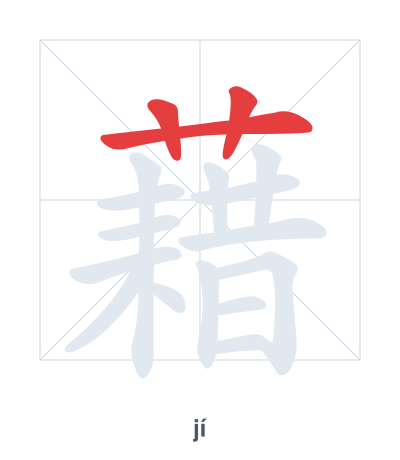
Open Hanzi Writer to see the animated stroke order and practice writing 藉 with real-time feedback.
The character 藉 (jí/jiè) is written with 17 strokes. Follow the standard Chinese stroke order: top to bottom, left to right, outside before inside. The radical 艹 is one of its key components.
Practice the correct stroke order with the Hanzi Writer app to see animated stroke-by-stroke guidance with real-time feedback.
藉 means By means of / To rely on.
This is a polyphonic character with readings: jí, jiè.
藉 is a compound character with the grass radical 艹 and the phonetic component 耤 (jí), which itself combines 耒 (plow) and 昔 (past). Originally meaning a straw mat used for sitting or bedding, it later extended figuratively to mean 'to rely on' or 'by means of,' as one relies on a mat for support.
💡 Memory Tip: Picture yourself relying on a thick grass mat (艹) while using an old plow (耒) from the past (昔) to till the field.
音乐能给孤独的心灵带来一丝温柔的慰藉。
yīn yuè néng gěi gū dú de xīn líng dài lái yī sī wēn róu de wèi jiè
Music can bring a touch of gentle comfort to a lonely soul.
他凭借着过人的毅力,终于登上了顶峰。
tā píng jiè zhe guò rén de yì lì zhōng yú dēng shàng le dǐng fēng
With his extraordinary perseverance, he finally reached the summit.
聚会结束后,桌子上杯盘狼藉,一片凌乱。
jù huì jié shù hòu zhuō zi shàng bēi pán láng jí yī piàn líng luàn
After the party, the table was a mess of plates and cups.
诗人们席地而坐,杯盘枕藉,意兴盎然。
shī rén men xí dì ér zuò bēi pán zhěn jiè yì xìng àng rán
The poets sat on the ground with cups and plates scattered around, in high spirits.
Open Hanzi Writer to see the animated stroke order and practice writing 藉 with real-time feedback.
✨ Animated stroke order · Handwriting recognition · HSK-graded practice · Free to use
The character 藉 has the radical 艹 (grass) on top, and the component 耤 below. The grass radical hints at the original meaning of a straw mat, which you rely on for sitting. Over time, the character came to mean 'by means of' or 'to rely on' because a mat is something you depend on for comfort.