臁 (lián) means "sides of the lower leg" in Chinese. It has 17 strokes with the radical 月.
Rated 4.2/5 in difficulty (advanced).
Appears in 3+ common words including 臁骨 (lián gǔ), 臁疮 (lián chuāng), 外臁 (wài lián).
Due to its 17 strokes, Hanzi Writer's error detection shows 臁 requires focused practice — most learners need 10+ attempts for consistent accuracy.
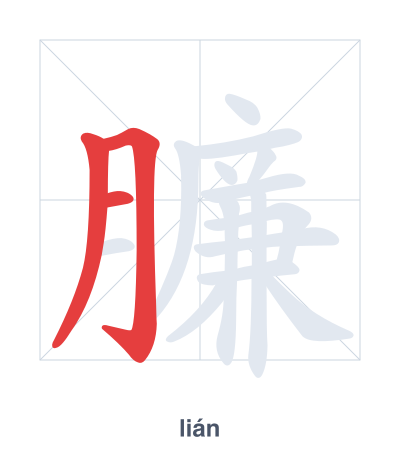
Open Hanzi Writer to see the animated stroke order and practice writing 臁 with real-time feedback.
The character 臁 (lián) is written with 17 strokes. Follow the standard Chinese stroke order: top to bottom, left to right, outside before inside. The radical 月 is one of its key components.
Practice the correct stroke order with the Hanzi Writer app to see animated stroke-by-stroke guidance with real-time feedback.
臁 means sides of the lower leg.
臁 is a phono-semantic compound. The left radical 月 (flesh) indicates it relates to a body part, while the right component 廉 provides the pronunciation lián and may hint at a 'side' concept (as in the side of a structure). Together they denote the sides of the lower leg.
💡 Memory Tip: Picture a fleshy moon (月) on the side of your calf under a small roof (广) that shelters two leg bones (兼) — that's the sides of the lower leg.
臁骨在小腿部位。
lián gǔ zài xiǎo tuǐ bù wèi
The shinbone is located in the lower leg.
他的臁疮还没好。
tā de lián chuāng hái méi hǎo
His leg ulcer hasn't healed yet.
外臁是指小腿外侧。
wài lián shì zhǐ xiǎo tuǐ wài cè
'Wailian' refers to the outer side of the lower leg.
Open Hanzi Writer to see the animated stroke order and practice writing 臁 with real-time feedback.
✨ Animated stroke order · Handwriting recognition · HSK-graded practice · Free to use
The character 臁 combines the radical 月 (meat/flesh) on the left and the phonetic component 廉 on the right. The 月 radical shows it relates to a body part, while 廉 contributes the sound and also means "side" or "sidelong", together forming the meaning "sides of the lower leg".