羸 (léi) means "weak; thin; exhausted" in Chinese. It has 19 strokes with the radical 羊.
Rated 4.2/5 in difficulty (advanced).
Appears in 3+ common words including 羸弱 (léi ruò), 羸瘦 (léi shòu), 羸顿 (léi dùn).
Due to its 19 strokes, Hanzi Writer's error detection shows 羸 requires focused practice — most learners need 10+ attempts for consistent accuracy.
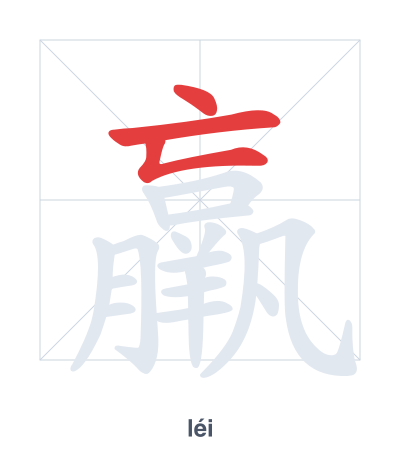
Open Hanzi Writer to see the animated stroke order and practice writing 羸 with real-time feedback.
The character 羸 (léi) is written with 19 strokes. Follow the standard Chinese stroke order: top to bottom, left to right, outside before inside. The radical 羊 is one of its key components.
Practice the correct stroke order with the Hanzi Writer app to see animated stroke-by-stroke guidance with real-time feedback.
羸 means weak; thin; exhausted.
| Character | 羸 |
| Pinyin | léi (lei) |
| Meaning | weak; thin; exhausted |
| Strokes | 19 |
| Radical | 羊 |
| Difficulty | 4.2/5 |
羸 is a compound character with 羊 (sheep) as the semantic component. The lower part combines 亡 (death) and 月 (flesh), suggesting a sheep so weak it appears near death and lacking flesh, hence meaning weak, thin, exhausted.
💡 Memory Tip: Imagine a sheep (羊) so exhausted that its ribs (月) are visible and it looks like it's dying (亡).
他的身体很羸弱。
tā de shēn tǐ hěn léi ruò
His body is very thin and weak.
老人显得很羸瘦。
lǎo rén xiǎn de hěn léi shòu
The elderly person looks very thin and frail.
旅途让他感到羸顿。
lǚ tú ràng tā gǎn dào léi dùn
The journey made him feel exhausted.
Open Hanzi Writer to see the animated stroke order and practice writing 羸 with real-time feedback.
✨ Animated stroke order · Handwriting recognition · HSK-graded practice · Free to use
羸 is composed of 羊 (sheep) on top and 𣎆 (a phonetic component) below. The sheep radical suggests weakness because sheep are often seen as gentle and frail animals, reinforcing the meaning of being thin or exhausted.