Hanzi Writer

How to Write 咾 (lǎo) — Meaning “a particle”

lǎo 9 strokes Radical: 口

咾 (lǎo) means "a particle" in Chinese. It has 9 strokes with the radical 口.

Rated 4/5 in difficulty (challenging).

Appears in 3+ common words including 咾咾 (lǎo lǎo), 呼咾 (hū lǎo), 咾咕 (lǎo gū).

Due to its 9 strokes, Hanzi Writer's error detection shows 咾 requires focused practice — most learners need 10+ attempts for consistent accuracy.
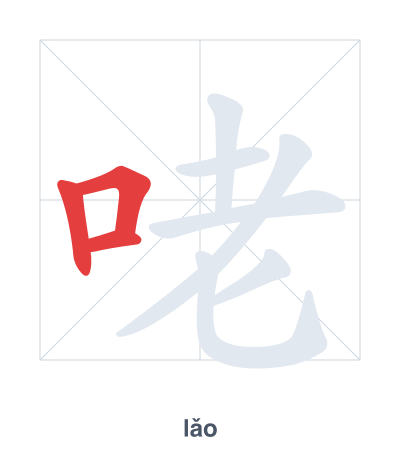
Stroke order practice for 咾 - lǎo

Practice Writing 咾 (lǎo)

Open Hanzi Writer to see the animated stroke order and practice writing 咾 with real-time feedback.

The character (lǎo) is written with 9 strokes. Follow the standard Chinese stroke order: top to bottom, left to right, outside before inside. The radical is one of its key components.

Practice the correct stroke order with the Hanzi Writer app to see animated stroke-by-stroke guidance with real-time feedback.

means a particle.

Character
Pinyinlǎo (lao)
Meaninga particle
Strokes9
Radical
Difficulty4/5

咾 is a phono-semantic compound: the mouth radical (口) indicates it relates to speech or sound, while the component 老 (lǎo, meaning 'old') gives the pronunciation. It is used as a grammatical particle in some Chinese dialects, often marking aspect or mood.

💡 Memory Tip: Picture an old person (老) opening their mouth (口) to say a simple particle like 'lao' with a sigh.

lǎo lǎo
sound of calling pigs
hū lǎo
to wheeze / to pant
lǎo gū
coral stone

他在那儿咾咾什么?

tā zài nà ér lǎo lǎo shén me

What is he muttering about over there?

他呼咾呼咾地喝汤。

tā hū lǎo hū lǎo dì hē tāng

He slurped his soup.

这种石头叫咾咕石。

zhè zhǒng shí tou jiào lǎo gū shí

This kind of stone is called coral stone.

Character Pinyin Strokes Radical
(current) lǎo 9
jūn 7
lìn 7
tūn 7
Stroke order practice for 咾 - lǎo

Practice Writing 咾 (lǎo)

Open Hanzi Writer to see the animated stroke order and practice writing 咾 with real-time feedback.

✨ Animated stroke order · Handwriting recognition · HSK-graded practice · Free to use

Frequently Asked Questions about 咾

咾 is made of 口 (mouth radical) on the left and 老 (old) on the right. The 口 radical indicates that this character relates to sounds from the mouth, while 老 provides the pronunciation lǎo. Together they form a particle used in onomatopoeic words like sounds made by people or animals.

Characters with Radical 口

Other 9-Stroke Characters