剌 (lá) means "to slash; to cut" in Chinese. It has 9 strokes with the radical 刂.
Rated 3.7/5 in difficulty (challenging).
Appears in 3+ common words including 剌开 (lá kāi), 剌手 (lá shǒu), 乖剌 (guāi lá).
Due to its 9 strokes, Hanzi Writer's error detection shows 剌 requires focused practice — most learners need 10+ attempts for consistent accuracy.
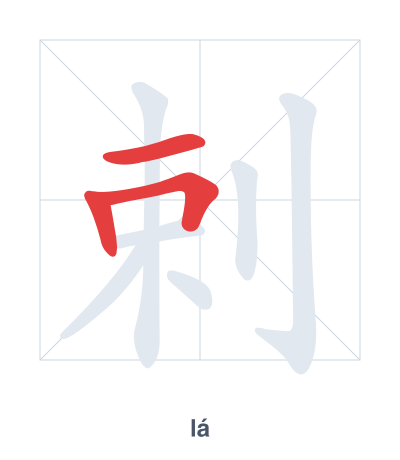
Open Hanzi Writer to see the animated stroke order and practice writing 剌 with real-time feedback.
The character 剌 (lá) is written with 9 strokes. Follow the standard Chinese stroke order: top to bottom, left to right, outside before inside. The radical 刂 is one of its key components.
Practice the correct stroke order with the Hanzi Writer app to see animated stroke-by-stroke guidance with real-time feedback.
剌 means to slash; to cut.
剌 combines the phonetic component 束 (shù, meaning 'bundle') with the semantic radical 刂 (knife), suggesting a knife slashing through a bundle. This visually represents the action of cutting or slashing apart something bound together.
💡 Memory Tip: Picture a knife (刂) slicing straight through a tied bundle (束) — that sharp slash is 剌 (lá)!
手被纸剌开了一个口。
shǒu bèi zhǐ lá kāi le yí gè kǒu
The hand got a paper cut.
这个草很剌手。
zhè ge cǎo hěn lá shǒu
This grass pricks the hands.
他的性格有些乖剌。
tā de xìng gé yǒu xiē guāi lá
He has a somewhat perverse and eccentric personality.
Open Hanzi Writer to see the animated stroke order and practice writing 剌 with real-time feedback.
✨ Animated stroke order · Handwriting recognition · HSK-graded practice · Free to use
剌 is composed of the radical 刂 (knife) on the right and the phonetic component 束 (shù, to bind) on the left. The knife radical indicates cutting or slashing action, which directly connects to the character's meaning of 'to slash' or 'to cut'. The left part provides a clue to pronunciation, though the tones differ.