廓 (kuò) means "outline" in Chinese. It has 13 strokes with the radical 广, and is HSK Level 7.
Rated 4.2/5 in difficulty (advanced).
Harder than 54% of HSK Level 7 characters.
Appears in 3+ common words including 轮廓 (lún kuò), 廓清 (kuò qīng), 廓大 (kuò dà).
Due to its 13 strokes, Hanzi Writer's error detection shows 廓 requires focused practice — most learners need 10+ attempts for consistent accuracy.
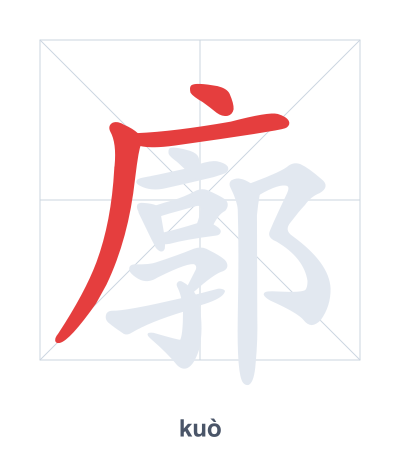
Open Hanzi Writer to see the animated stroke order and practice writing 廓 with real-time feedback.
The character 廓 (kuò) is written with 13 strokes. Follow the standard Chinese stroke order: top to bottom, left to right, outside before inside. The radical 广 is one of its key components.
Practice the correct stroke order with the Hanzi Writer app to see animated stroke-by-stroke guidance with real-time feedback.
廓 means outline.
As an HSK Level 7 character, 廓 is an intermediate-level character.
廓 combines the radical 广 (roof or cliff) with 郭 (outer wall), originally depicting a building surrounded by defensive walls. The outer wall outlines the boundary of the structure, giving the character its meaning of 'outline' or 'contour'.
💡 Memory Tip: Picture a huge roof (广) covering a city wall (郭) that draws the outline of the entire city.
山的轮廓很美。
shān de lún kuò hěn měi
The silhouette of the mountain is very beautiful.
廓清了所有问题。
kuò qīng le suǒ yǒu wèn tí
All problems have been cleared up.
房间很廓大。
fáng jiān hěn kuò dà
The room is very spacious.
Open Hanzi Writer to see the animated stroke order and practice writing 廓 with real-time feedback.
✨ Animated stroke order · Handwriting recognition · HSK-graded practice · Free to use
The character 廓 is composed of the radical 广 (roof or shelter) on the left and the component 郭 (outer city wall) on the right. Together they suggest an outline or boundary, like the shape of a city wall surrounding a building. This structure directly gives the meaning of "outline" or "contour."