喹 (kuí) means "quin- (chemical prefix)" in Chinese. It has 12 strokes with the radical 口.
Rated 4.2/5 in difficulty (advanced).
Appears in 3+ common words including 喹啉 (kuí lín), 氯喹 (lǜ kuí), 喹诺酮 (kuí nuò tóng).
Due to its 12 strokes, Hanzi Writer's error detection shows 喹 requires focused practice — most learners need 10+ attempts for consistent accuracy.
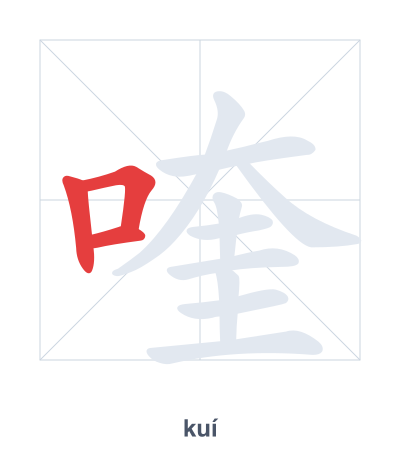
Open Hanzi Writer to see the animated stroke order and practice writing 喹 with real-time feedback.
The character 喹 (kuí) is written with 12 strokes. Follow the standard Chinese stroke order: top to bottom, left to right, outside before inside. The radical 口 is one of its key components.
Practice the correct stroke order with the Hanzi Writer app to see animated stroke-by-stroke guidance with real-time feedback.
喹 means quin- (chemical prefix).
喹 is a phono-semantic compound: the mouth radical (口) serves as a semantic hint for its use in phonetic loanwords, while 奎 (kuí) provides the pronunciation. It was created as a Chinese transliteration for the chemical prefix 'quin-' found in terms like quinoline.
💡 Memory Tip: Imagine a giant mouth (口) in a chemistry lab chanting 'KUI!' as it stamps the chemical prefix 'quin-' onto beakers.
这种药物含有喹啉。
zhè zhǒng yào wù hán yǒu kuí lín
This medication contains quinoline.
氯喹是一种抗疟药。
lǜ kuí shì yī zhǒng kàng nüè yào
Chloroquine is an antimalarial drug.
医生开了喹诺酮类药。
yī shēng kāi le kuí nuò tóng lèi yào
The doctor prescribed quinolones.
Open Hanzi Writer to see the animated stroke order and practice writing 喹 with real-time feedback.
✨ Animated stroke order · Handwriting recognition · HSK-graded practice · Free to use
喹 is a left-right character. The left part is 口 (mouth radical) and the right part is 奎 (kuí), which gives the pronunciation. The meaning comes from its use as a phonetic character in chemical terms, so the components do not directly reveal the meaning "quin-".